Thursday, 28 February 2013

A genealogical jolt

Outside, the snow is clinging to the branches of the tree like blobs of meringue.  You can hear the occasional soggy plop as a cold, wet ball gives into gravity.  I've been on the receiving end a couple of times over the past thirty-six hours.  They're heavier than you think and your shoulders jolt upwards as the snowball bears down.

I've had a genealogical jolt today.  I've been working my way through the London Electoral Registers (1832-1965), checking which of my London ancestors had enough property to vote in the nineteenth century.  An odd pang of pride has been the appearance of the names of two of my great-grandmothers and a couple of those of the Resident Fan Boy as suffrage was extended to "selected women over 30" in 1918.

However, as is the usual case, my checking through the data has led to a re-examination of some parish records -- and to the discovery of a third marriage for one of my great-great-great-great-grandmothers and the realization that this third marriage was to another great-great-great-great-grandfather.  That is, a different 4xgreat-grandfather than the one she married the first time.

Which seems to indicate that a pair of my great-great-great-grandparents were step-siblings.

As far as I can tell, this wasn't illegal in 1813 and isn't illegal now.  They didn't even grow up together, as their respective parents were well into middle age when they found each other.

Still, it's a bit like a thick wet smack on the top of my head.

Thursday, 31 January 2013

The pendulum is the pits

When January began, we were still in the midst of the twelve days of Christmas.  The snow people made by neighbourhood children grew under layers of new snow.  I can't ever remember snowmen lasting beyond a day or two.  These lasted for weeks.  However, the pitiless pendulum of the new year has been swinging back and forth between piles of white, and pewter freezing rain.

Last week, I carefully picked my way around the slick streaks and solid slippery puddles along Iris Crescent and saw that the cheerful and slightly askance couple who seemed to be cautiously watching to see what the Accent Snob would do last month had been reduced to emaciated pillars this month.

The pendulum swung again, and a truck-cum-snow-plough was trapped on Bertrand Street one Saturday evening.  Someone had drawn a triumphant smile in the blade-devouring drift.

This week, we've had hip-high hills of white washed away (nearly) by rain which was dried (nearly) by howling winds this morning before the temperatures dropped, freezing treacherous smears across the sidewalks.  And we've still got February to come.  March and April usually aren't that much better here in Hades.
This is my tenth NaBloPoMo.  I began with February 2009, followed by September that same year. In 2010,  I did March, August, and November. I blogged for the whole months of April and October in 2011, and my NaBloPo-months for 2012 were May and July.  For almost each month in which I've participated, I've gone through my diaries to see what patterns emerged over my years of journalling.  Looking over past Januarys was rather depressing.  It's such a damn dark month, mostly in various hues of grey.  I seem to have had rather more friends die in January than other times of the year, but I don't feel like checking, thank-you very much.  I suppose January has usually been a time for facing reality for me.  Too bad the light is so poor.

 I plan to NaBloPoMo in June.  I'll still be blogging in the meantime, but not nearly as regularly. I'm tired, and there are things that need doing before I come out swinging again.

Wednesday, 30 January 2013

Psychopaths I have known

Last autumn, I came across this article in the Globe and Mail which includes an interview with author Kevin Dutton and an overview of his book The Wisdom of Psychopaths. I felt a dropping in my stomach as I read it, because at the end of the article were two lists: one denoting leadership traits, the other the corresponding psychopathic traits. The first list came fairly close to describing my father. The second list pretty much nailed him. I sat in a mild state of shock for a few minutes, then logged into my local library's web site and put a hold on the book.

Dr Kevin Dutton begins The Wisdom of Psychopaths with tales of his own father and his father's audacity. Neither Dutton's dad nor mine was a serial killer (so far as I know). This is the point. We use the term "psychopath" as a synonym for "serial killer". This isn't so, and Dutton is by no means the first person to make this point. Most of us probably personally know people living with autism, Parkinson's Disease or schizophrenia. (I certainly do.) Why wouldn't we also know functional psychopaths?

Dutton describes how the very qualities that help politicians, surgeons, military intelligence operatives, CEOs and sales people rise in their professions and succeed in what they need to do are similar to traits shared by some of the most dangerous people in our society. He calls these "The Seven Deadly Wins": ruthlessness, charm, focus, mental toughness, fearlessness, mindfulness (as in living in the here and now), and action ("Psychopaths," Dutton declares, "never procrastinate.").

As I read, I thought of the possible psychopaths I'd encountered in my own life: a boy at school who could turn friendliness on and off like a tap, a teaching partner whose relationships with the students we shared made me uneasy, at least two of the Resident Fan Boy's bosses, and yes, my own charming, reckless, and heartless father.

I admit, though, I'm nothing but an armchair psychologist and this book, written in a glib, popular-science style, is nothing more than food for thought. An interesting read, but not something on which to base your life philosophy. Unless, like a psychopath, you have little in the way of a conscience.

Tuesday, 29 January 2013

Through a bus, darkly (Write of passage number twenty-eight)

This is a January story, but not of this January. One of the reasons I do NaBloPoMo is to force myself to do posts I always meant to do. Last January, from what I can dimly and reluctantly recall, was a blur of grey slush and pewter-coloured ice. It was a late Wednesday afternoon, and a cold downpour had not quite succeeded in washing the snow from the streets. On Elgin, a water pipe had burst. I took younger daughter to a coffee shop we had loved when we first came to Hades, where the staff was now sullen and unwelcoming. (It has since closed down.)

After dropping her off at her voice lesson, I transferred outside the Rideau Centre with a queue of fellow passengers who barely restrained themselves from shoving each other on to a crowded bus. It was my custom to sit further back, but this evening all seats in the back were already occupied and I reluctantly took one of the "courtesy seats" which face the sideways seats at the front.

I had to step around a young mother in a hijab who, after trying to peer through the mud-caked windows into the gathering darkness, suddenly realized she had to get her stroller off the bus, which meant pushing through crowds of damp and crabby people still trying to board. I caught the eye of a woman sitting across the aisle, smiled and said: "I don't think she knew where she was." The woman seemed to think I was making a criticism, and earnestly explained that it wasn't the mother's fault. Before I could reply that this was what I meant, we were blocked by a wall of standing passengers.

An older lady sitting cater-corner to me in the sideways seat took this as a cue to chat with me. Now, I had caught something from younger daughter just at that Christmas. It was four weeks later and whatever it was had worked its way from my head into my chest, then up into my sinuses and into my ears so that now I was rather hard of hearing. (It would not clear up until mid-February.) I was too cold, wet, and tired to explain this to the lady, and wished I had donned my ear-buds. I smiled and nodded, not being able to make out what she was saying. It didn't take me long to realize that this tactic had been a big mistake. She kept chatting in a low, companionable tone until we turned off Dalhousie on to Murray Street. It was at this point that a formidable lady in an African headdress planted herself between us, and in deep mellifluous tones started to tell us off.

This meant five minutes of my looking in bewilderment between the two women, wondering what on earth I'd missed. Chatty lady chuckled disbelievingly at formidable lady, who then turned to me and seemed to ask what I had to say. I could only manage: "I'm afraid I can't hear you."
"Well, isn't that good for you?" she said, before sailing to the back of the bus, which was now largely empty, flinging back: "I am not your cleaning lady...."

I wondered briefly if we were enacting a scene from the film The Help which was big at that time and which, of course, I hadn't seen. Chatty lady gave me a "Can you believe that?" sort of look, along with a comment that I still couldn't hear, and I staggered off the bus, resolving never to pretend I can hear when I can't and to always try to sit near the back of the bus.

I realize at some point I'll be really old (and undoubtedly deaf as a post) and will have no choice but to sit at the front, but I'll cross that bus when I come to it.

Monday, 28 January 2013

Overkill

When I was writing up my review of Laurent Binet's novel/blog/series-of-unfortunate-events HHhH last night, I planned to mention my previous encounters with Reinhard Heydrich. Not personal encounters, thank goodness; Heydrich died in 1942 and was perhaps one of the most terrifying and deadly members of the Nazi administration -- which is saying something. However, I'm doing NaBloPoMo this month and I submitted my post within minutes of midnight as it was.

Binet mentions the television film Conspiracy in his book, which is indeed a memorable movie about the Wannsee Conference with a cast featuring such remarkable actors such as Kenneth Branagh, Stanley Tucci, David Threlfall, Colin Firth, plus about a dozen other actors who are familiar, not because they are famous, but because they are hardworking British (mostly) character actors.

Here is a taste of Branagh's and Tucci's interpretation of how Heydrich and Eichmann ran the meeting:

However, as chilling as Conspiracy is, the production team couldn't resist adding dramatic tension by making Threlfall's character and Firth's character more sympathetic, "good Nazis" (with some scruples, however faint) to contrast with the "more evil Nazis" (no scruples whatsoever). It's a disturbing aspect of an already disturbing reenactment.

Besides, I couldn't help comparing it with The Wannsee Conference (Die Wannseekonferenz)(1984). I stumbled upon this late one night on a PBS channel some years ago. At the time, I was bewildered, having never heard of the Wannsee Conference. I saw men, in various Nazi uniforms, chatting genially, sipping drinks, then sitting through what appeared to be a typical business meeting complete with maps and graphs. It makes the agenda all the more horrifying. No added drama is needed:

Heydrich, the "Butcher of Prague", is portrayed here by Dietrich Mattausch a busy and distinguished German actor who was born, ironically enough, in Sudetenland, now part of the Czech Republic.

A couple of years ago, I read an online review of this film by someone who had attended several business meetings in Germany. He said they were much like this one. Presumably without the swastikas and the outline for the murder of millions.

Maybe I've had enough of this kind of thing for a while. I've been having nightmares. On the other hand, just wait until you hear what else I've been reading this month...

Sunday, 27 January 2013

HHhH (The brain of Himmler is Heydrich)

This may be a first. I'm not a consumer of the latest books. I'm a slow reader and a picky reader and most things I read have been published for at least two or three years, usually longer.

I first heard about HHhH about six weeks ago at Scott Pack's blog Me and My Big Mouth. He'd listed it as Number Two of his top books of 2012. It looked interesting, so I put a hold on it at the library, and it came up surprisingly quickly. I had just begun reading it when I spotted it at The Bluestalking Reader blog, this time because HHhH has made the shortlist for the National Book Critics Circle Awards 2012.

So some pathetic excitement in my life: I've actually read something that's up for an award. The irony, of course, is that HHhH was published in French in 2009; it's the translation that is copyright 2012. I wonder how much of the award is for the author, and how much for the translator (a man from Nottingham named Sam Taylor who has written three novels of his own)?

This book is about Reinhard Heydrich,
head of the SS, a chief creator of the "Final Solution", and terror of Prague, where he was eventually assassinated in 1942. I first heard of him when I was in elementary school, reading a simplified Scholastic version of William Shirer's The Rise and Fall of the Third Reich, which included a brief and rather sanitized description of what the Nazis did to the village of Lidice, Czechoslovakia in reprisal after Heydrich's death. To put it simply, they killed everybody except a handful of kids who could pass for Aryans. They even shot the dogs before razing the place.

This story is also about Jan Kubiš and Jozef Gabčík, the Czech and the Slovak assigned to kill Heydrich. Apart from what Heydrich represented and the horrors he unleashed, according to Laurent Binet, the Czech government-in-exile needed a powerful act of resistance so that London would remember to revoke the Munich Agreement after the war.

To interweave the stories of the marksmen and their target, Binet writes -- not a novel exactly, but a series of impressions about writing a novel about Heydrich and Kubis and Gabčík. In 257 sort of blog posts, Binet veers from Heydrich's childhood and rise to power, to the choice of Gabčík and Kubiš for the suicide mission, from Babi Yar to a brutal and possibly mythical football match between Nazis and Ukranians, from whether Heydrich's Mercedes was black or dark green to which of the Czech families who aided Kubiš and Gabčík (the vast majority of whom were shot or gassed) will be sacrificed from the narrative for brevity's sake.

Does it work? Well, yes. It's a bit distracting at times, especially when Binet hauls us back into the present to stew over details, but the final third of the book as we hurtle toward the assassination and its horrific aftermath is engrossing -- and frankly getting jerked into the present from time to time is a relief.

Will it win the award? Heck, I don't know; I never read the latest books, so I have no idea what the competition is like. This book is worth reading though, whether it wins the award or not.

Saturday, 26 January 2013

If you go down to the woods today

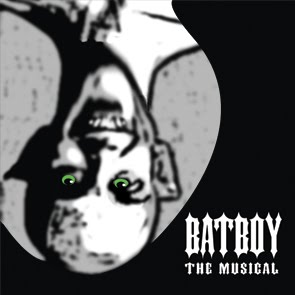
We like to support local theatre when we can. This was a musical at the Gladstone Theatre, featuring Zac Counsil, whom we had seen in a clever three-person adaptation of Macbeth last year, and the amazing Kris Joseph, who was one of the very best actors in Ottawa before he moved west to Edmonton. I knew next to nothing about this play -- it's a cult musical from the 1990s -- but we were warned: "Stage fog; prop guns; intercourse bears". Intercourse bears?

Well, the first half was quite entertaining. Even before the lights went down, the fog machine spewed interesting white billows across the black stage. Like real clouds, they floated into interesting shapes; one looked for all the world like the jaws of a smoky crocodile reaching out to snap the audience. When the show began, the acting was fine, and the singing strong. Kris Joseph, as expected, took over every scene he was in as the troubled doctor who saves the Bat Boy because he hopes this will save his marriage. (Things get nasty when it doesn't.) I was rather disappointed by the lack-lustre response of the audience; the cast was working so hard.

It all fell apart a bit after intermission. A young boy across the aisle who appeared to be about four, seemed to lose interest during the first musical number and started snapping pictures with his iPhone (or whatever it was -- he had been playing games on it during the intermission when the Resident Fan Boy heard him tell the couple behind him that his mum was in the cast). He snapped away steadily for about ten minutes until the man behind him firmly grasped his shoulders.

They lost me for good when the cute furry animals start copulating while singing about inter-species harmony. I saw the bears but didn't see them having intercourse. I was too busy trying not to watch a tiny bunny do unspeakable things to Grover the Monster. It's supposed to be funny and satirical; I thought it was gratuitous and over-the-top. This play is being marketed as "heart-warming".

After the big denouement, which involved a women being sexually assaulted by bats and a bit of inadvertent incest, I turned to the Resident Fan Boy and joked weakly: "My review for this would be: 'If you liked Avenue Q, you'll probably like this."

Back home, on Skype, we tried to explain to elder daughter in Halifax about the puppets having sex. Younger daughter gasped from the dinner table: "The puppets were having sex????"

Somehow, I don't think she's picking up much from the life discussions at her school.

Friday, 25 January 2013

Someone is WRONG on the internet

One of my distant cousins (well, she's something like my second cousin once removed which, in family research terms, is practically immediate family) just sent me an email apologizing for a flippant comment she had made about two babies in our mutual branch of the family tree who died "of teething". She said her comment was insensitive. Now, seeing as these babies died well over a hundred years ago, I thought they were well beyond hurt feelings, and told her as much, adding that steering around the sensitivities of the living is far more perilous, speaking from sad experience.

I must admit though, if I were as scrupulous as my cousin, I'd probably have smoother sailing online.

I've always thought of myself as a tactful person, but then everyone thinks s/he is a good driver, or has a sense of humour, so I may be deluding myself. Especially considering I don't drive. I can also think of way too many occasions where I either put my foot in my mouth or was simply misunderstood. Online, the opportunities for inadvertently pushing someone else's buttons seem to quadruple, no matter how meticulous the proofreading. Sometimes, all the emoticons in the world cannot save you. (Granted, there's compelling evidence that I shouldn't be allowed anywhere near emoticons.)

The area of family research is particularly sensitive, because, not only are you dealing with dead family members, but you are addressing people who feel deeply proprietary about said family members. I include myself in this feeling, you understand. It has gotten me into trouble more than once.

I have a public tree at Ancestry.co.uk. Now right there, we have a controversy, because there are family researchers who will tell you that it is foolhardy to have a public tree. I can see what they mean. Over the ten or so years I've been researching my family online, I've seen more and more people simply copy down the information off others' trees, without a word to the original researchers. I blame ads such as this one from Ancestry.ca: We'll do the searching for you.
You don't have to know what you're looking for...

Right. It turns out there are a lot of people out there who not only don't know what they're looking for, they don't know how to look for it. They seem to have no concept of research protocols, such as looking for evidence in more than one place, or noting where they got their information. With little idea of geography or history, they make assumptions and their family trees are full of other people's relatives, not their own. For some reason, the ads don't mention this.

There's no doubt that my public tree has resulted in stunning finds and wonderful connections. I'm loath to give it up. It's a bit too late anyway as scores of people have made off with my research and what's worse, my family photographs. Ancestry, of course, encourages you to add family photos, with a gentle warning not to post pictures of living people. Quite right, too. What they don't tell you is that other "researchers" will copy your photos to their trees. I wouldn't mind so much if these people were actually related to me, but I've checked, (it's not hard) and nine times out of ten, they've made a fatal error in their direct line. For example, there was the case of a woman in Ontario who had been painstakingly copying down everything in my tree. I'd make entries, within a day the data appeared on her account. (Ancestry notifies you when records you've saved are saved to another tree.)

I checked and quickly saw that she was claiming one of my great-great-great-aunts as her great-great-grandmother, despite the fact that her g-g-grandmother was born forty miles from the birthplace of my g-g-g-aunt, in a different year, and they had married different people.

As a matter of fact, I'd been in touch with her before on another issue, asking why she had my great-great-great-grandmother married to both my great-great-great-grandfather and his brother, having children well after her death. Pleasantly -- and predictably, she said she'd got it from another tree. I was reluctant to contact her again; besides, I have this rule for myself that I don't intervene with someone's research unless it involves one of my people in my direct line. (Otherwise, I'd be intervening all the time; the problem is that prevalent.) I watched for weeks as she added people, photos, and records from my tree to hers. The final straw came when she posted my late father's address from the nineties, a condo where his widow still resides. This was around Christmas Day and I made myself wait three days before sending a carefully-worded email a) pointing out that my father was entirely unrelated to her; b) laying out the evidence for my great-great-great-aunt not being the same person as her g-g-grandmother; and c) adding, a little unfairly, that my stepmother had had an unwelcome contact since her address had appeared in this woman's tree. (This was true, but I doubt the interloper had got the information from Ancestry.) I got a very apologetic message with the promise to dismantle that part of her tree. It's still up there, but my late father's address is gone.

So that worked out quite well. Within a few weeks, trouble came from another quarter. A lady in Australia was posting photos of some of my ancestors. That's not awful in itself, what usually happens is that a note will automatically appear on that person's tree stating who the original submitter was, along with any information about the photo that the original submitter included. This woman had copied the pictures to her computer, re-labelled them and posted them again, without the accompanying information. I knew this because, as these people are my ancestors, "her" pictures turned up in my list of possible leads. (These weren't pictures of her ancestors, by the way. My great-great-grandparents are her husband's distant cousins, not even in his direct line.)

I didn't wait three days before contacting her. I should have.

I was pretty damn mad and even through I tried to establish a tone of polite bewilderment, I probably came across as angry. (Gee, d'you think, Persephone?) I said that copying photos and re-submitting them as her own defeated the spirit of family research and that this was one of the reasons I no longer share my photos on Ancestry. At first glance, her response seemed quite charming. She explained that due to broadband limitations, she preferred to transfer photos to her own computer, that she derived great pleasure from sharing selectively photos that "gave faces to" relatives, and that she was sorry I would no longer be sharing photos because my tree was "wonderful". She rather spoiled the treacly stuff by apologising "if" I were offended. (Using the conditional tends to negate an apology; it suggests that somehow you aren't, or shouldn't be, upset.) She also put "copying photos and re-submitting them as mine" all in capitals, effectively shouting at me.

I replied that asking permission before posting other people's photos is not required, but that it is courteous, and she could consider at least giving credit to the relative who had carefully restored and digitalized the photographs. I also couldn't resist adding that the idea of her "selectively sharing" photos with strangers didn't give me much comfort.

You can probably guess what happened.

The return message was very short. She was deleting my photos, she said. Consider myself blocked, she said. Oh thank goodness, I thought. I was just on the verge of blocking you.

Sigh. What have I learned from this? Probably nothing I didn't really know already.

First off, and probably most important: I succumbed to the siren call of correcting someone who is wrong on the internet. This has been stated in beautiful simplicity by this xkcd web comic classic, entitled "Duty Calls" by Randall Munroe:

If someone has made an error in fact, judgment, taste, etc., and I'm falling over myself to set them straight within the next few minutes, I should stop myself. In this case, I should have waited three days for before posting each response.

I still believe she was wrong. Not in a legal way, of course, once I'd posted those photos, they belonged to the world, and I won't be posting ancestral photos on Ancestry again. In terms of research, courtesy, and the plain old Golden Rule, she was mistaken. However, I didn't fare so well in the Golden Rule department myself. I was too angry. Simple as that.

Thursday, 24 January 2013

When love-sick teens get hold of French pop songs

Have a listen to this 1966 recording by Sylvie Vartan (who, amongst other things, was married to the "French Elvis Presley" Johnny Halliday for fifteen years) of a song called "Quand un amour renaît"
Non, rien n'est jamais fini
Essayons
Par tout ce qui nous unit
Pardonnons

Quand un amour renaît
Il faut lui laisser
Une chance encore
Pour nos erreurs du passé
Il faudra nous aimer
Encore plus fort

Car il y a entre nous
Plus que l'amour
Je crois que nous serions fous
Et je suis pour

Quand un amour renaît
Il faut lui laisser
Une chance encore
Pour nos erreurs du passé
Il faudra nous aimer
Encore plus fort

Quand un amour renaît
Il faut lui laisser
Une chance encore
Il faut tirer un trait
Et ne pas trop chercher
Qui a eu tort

Et tous ceux qui sont partis
Sans un pardon
Sachant que rien n'est fini
Regretteront

Sound familiar? Not fabulous lyrics, but those in the English version (based on this original French song) are probably quite a bit worse:

And when I see the sign that points one way
The lot we used to pass by every day

Just walk away, Renee
You won't see me follow you back home
The empty sidewalks on my block are not the same
You're not to blame

From deep inside the tears that I'm forced to cry
From deep inside the pain that I chose to hide

Just walk away, Renee
You won't see me follow you back home
Now, as the rain beats down upon my weary eyes
For me, it cries

Your name and mine inside a heart upon a wall
Still finds a way to haunt me though they're so small

Sounds like something on the creative writing page of the school yearbook, doesn't it? That's because the English lyrics were written by a love-sick sixteen-year-old.
I got the story from a feature on CBC Radio Two's late afternoon show Drive called "Rear View Mirror". You can read it here, and see some other songs inspired by this one that you may not have expected.

Oh, and I quite love the song. I liked the lyrics better when I was a love-sick adolescent, though.

Wednesday, 23 January 2013

Another one bites the snow-drift

Today is quite possibly the coldest day of the year in Hades. This morning Environment Canada informed us that it was -28 Celsius with a -40 wind chill. That was when younger daughter headed off to school. She had a lift, thank heaven.

This was also the day that the developer who wants to build a three-unit condo next door decided to demolish the house that has stood on the corner for I-don't-know how many years -- probably about 80 or 90, as that's how old our semi-detached is. They put up the signs and fences first thing and ripped out the shrubbery and trees before using the earth-mover to scrape about four feet of snow off the roof. We live in the far side of the semi-detached, so I only knew the big-time demolition had begun by the muffled booms and crunches. The other clue was when a man who lives in an apartment block across the street brought out his well-bundled preschooler of indeterminate sex to sit on the stoop and watch. It was warmer then, about -25 and a wind chill of -37. Hey, Ottawa kids are tough.

By the time I took the Accent Snob out for his midday yank around the block -- he hates the cold and men with trucks and implements of destruction even more so -- the house next door was about a third gone. It looked like it had been gobbled by Hansel and Gretel, provided of course they had scary appetites and a taste for nails and drywall.

When I returned home from escorting younger daughter from her school to her music lesson, only a pile of rubble remained. All I remembered of the people that lived there were their pleasant smiles when passing me on the sidewalk, and the sound of piano music on warmer afternoons. Warmer than this one, for sure -- I had an ice cream headache with no ice cream.

Construction in Hades, as far as we've been able to figure, lasts about two years. This should be fun.