Showing posts with label genealogy. Show all posts

Monday, 11 May 2026

Share and share unlike

For the first couple of decades of our respective lives, Double Leo Sister and I were so unalike, and so seldom seen together, that many people mildly acquainted with us were unaware that we were related.  

This has changed steadily as we have aged and we're pretty similar now - at least in appearance and mannerisms, if nothing else.  

About five weeks ago, in the wake of our mother's death, I handed an Ancestry DNA kit to my sister.

Shortly afterwards, she managed to break her humerus and tear her rotator cuff. (This was just what happened, not cause-and-effect.) 

At any rate, I was pretty sure she had forgotten all about the test, and was preparing to remind her when she was down-Island, that if she really wasn't interested, she should give the kit back, because it's pretty damn expensive.

No, she said, she'd tested and furthermore, had heard back weeks ago.

No sign of her in my DNA matches, nor in those of my mother, whom I tested five years ago. 

You're thinking of all those stories, aren't you?  Those news items about people getting a DNA kit for Christmas and discovering, with a shock, that they're not related by blood to those they grew up with?

We should be so lucky. (I'm joking, but I think it crossed both our minds.)

Apparently, Ancestry now requires you to turn on match-sharing before it becomes visible to your matches, which, I guess, is a good idea, but it makes me wonder how many other matches I'm not seeing, because it's clear that most people take the tests to get the nebulous ethnicity estimate  --"estimate" essentially means "guess", people -- and don't bother with the matches at all.

Anyway, my brother-in-law, the Jolly Not-So-Green Giant, figured out what icon to switch, and there she was:  "Full Sister" - a slightly lower number on the centiMorgans she shares with Demeter, with nearly twice the segments that I have in the DNA match with Demeter.  Also, her ethnicity estimate is quite different than mine, which happens to be way more similar to my mother's - interesting, but in the long-run, not that significant.  Double Leo Sister has clearly inherited a different set of DNA from our shared ancestors; that's how DNA works -- it's more random that you might think.

Have I lost you yet?

I tried to talk about all this with my sister and brother-in-law, but like most people, they're really not into family history research, and they soon changed the subject. My sister is into Creative Anachronism and stained glass.  My brother-in-law is into computers and fantasy novels.  I'm not crazy about any of that.

I let them chat about these things with the Resident Fan Boy, while I started using my sister's shared matches to identify even more of our mother's and my shared matches.  

They went home early.

Tuesday, 5 May 2026

Theories of relativity


I've been on one of the most peculiar genealogical journeys I've experienced thus far.

And that's saying something.  Both the Resident Fan Boy and I have weird family histories.  (I've long suspected that there are no other kind, not if you're doing your research properly.)

This latest family foray began innocently enough.

John Reid, in his blog Anglo-Celtic Connections, regularly reports when newspapers become available at FindMyPast, and some months back, one of these periodicals was from Norwood, in Surrey (now Greater London, I think), where the Resident Fan Boy's paternal ancestors dwelt in the 19th century.

So I started a search, but couldn't find entries for the surname of those particular ancestors.  Instead, I found a item in the Herne Bay Press, about the 1930 funeral of one of the RFB's great-aunts, under her married surname, of course.  She'd lived and died in Herne Bay, Kent, but was being buried, like many of her family members, in West Norwood Cemetery. It was one of those goldmine genealogical finds: supplying a long list of mourners, saying who sent flowers, and giving a hint of which family members may have been speaking to each other, in the aftermath of a family scandal.

As usual, this led to a happy couple of hours finding new records, and updating profiles.  

To my astonishment, I found the said great-aunt's death certificate, posted by a new and unfamiliar account.  

I flatter myself as being a family researcher of some experience, so I did searches of birth registrations and British business profiles, and finally identified the account as being connected to a first cousin once removed of the Resident Fan Boy.  It turned out her husband's business was a sixteen-minute stroll from where elder daughter had been living in South Wimbledon a couple of years ago.  (I'd had this cousin's father married to the wrong woman, so she was utterly new to me.)

Delighted by the discovery and the closeness of the connection, I told the Resident Fan Boy all about it that evening, and he was politely interested -- after I'd hauled out a couple of graphs to show him how he was related.

I had no immediate plans to contact this relative, but it was taken out of my hands the very next morning, with a text from elder daughter:  "Should I respond to this?"

"This" was a message via FaceBook Messenger.  It was the very cousin I had just identified!

I was startled, to say the least, and puzzled.  Why was this cousin reaching out to my daughter, and, how on earth had she identified and found her?  My tree is private, and my daughters' information doesn't appear on it, anyway.

However, I had carefully tracked this person's lineage, and she was exactly who she said she was, so I reassured elder daughter, told her how she was related, and gave her permission to pass on my email address.

Elder Daughter's Rare Paternal Cousin (or EDRPC, until I can think of something catchier) got in touch very quickly, and revealed the remarkable (and frankly terrifying ) ricochet of logic that had led her discovery of her second cousin. 

Not seeing any descendants for my late father-in-law nor his brother - Ancestry doesn't show living people, thank goodness - she did a google search and found an independent site -- with all our names...

There's a reason for this.  Years ago, when still a newby genealogist, I encountered a Texan online, who was researching one of the distaff branches of the Resident Fan Boy's family.  She was something like an eighth cousin. 

Being a novice, I didn't recognise the tell-tale signs of a rabid and ruthless researcher, and we exchanged details.  I didn't quite grasp at the time that one never shares details of living people without careful vetting.  Too late, I asked her politely to not publish or share the information I'd given in a family report I'd forwarded to her.  She got quite huffy, saying that, in all her years of researching, she'd never received such a request. 

It was only some years later that I stumbled across her "freepage" - with the FULL NAMES (sorry, am I screaming?) of my husband, children, and, worst of all, my living in-laws.  the Texan lady had appended an utterly pointless "information reheld" in brackets after each name. I was livid and wildly embarrassed, but there was little I could do, but learn from the experience. 

The EDRPC also found the page I had created for my late-father-in-law's dad at the Imperial War Museum's web site, recognising my name, then she stumbled across the Resident Fan Boy's uncle's obituary from several years ago, where both the RFB and I had left our condolences, which further confirmed our names and relationship.  

So she entered the RFB's name into the search engine with the keyword "Canada", and up came the pièce-de-resistance-is-useless:  a news item from his church, featuring not only our names, our neighbourhood, and the location of our daughters, but the name and breed of our cat!

All this, the EDRPC told me, made me think it was very likely to be all of you.

(No kidding, cuz.)

Social platforms led her to a likely variation on elder daughter's name, including being about the right age, and a Canadian living in London.  So she sent out feelers to elder daughter.

"Isn't it amazing/terrifying the details you can track on the internet!" the EDRPC messaged me brightly.

Of course, she's lovely.  Nearly all our relatives are.

We exchanged all sorts of family photos and greetings on holidays.  She's delighted to finally have some cousins, a rare commodity on her side of the family. Furthermore, while tidying up my research to share with her - which she has firmly pledged not to publicise - I discovered a possible key to yet another longtime family mystery.

But I'm not posting that here.  I'm still clinging to some of my illusions and delusions of online privacy.

Sunday, 3 May 2026

Remember me to Leicester Fields

In the continuing War of the Algorithms, I've really been needing palate-cleansers. 

This latest battle is with YouTube. It's creepy enough when ads for something I've recently ordered online stalk me throughout a video I'm watching. 

However, in the past few months, it seems that the content I'm sent is narrowing alarmingly.  Even accidental pauses while scrolling though suggestions count as indications I might be interested, when I'm really not.
 
Last week, I encountered a time-lapse video, which picked a Paris intersection, and ran through possible sights seen from this vantage point from Before the Common Era to the present. Foolishly I decided to suppress my distaste for AI, and watch. It was fairly interesting, although I suspect a factor in my enjoyment might have been my not-so-detailed grasp of French history. 

I counted it as a guilty pleasure. 

Predictably, a couple of days ago, a similar video appeared in my "recommended" list -- this one showing a time-lapse view of London from someone hovering a bit back from the south bank of the Thames, looking towards Westminster starting just before the Roman occupation, and gradually, the palace of Westminster appeared (some time in the eleventh century), followed by the other familiar landmarks.

Just before the Westminster bridge began spanning the Thames in the mid-1700s, my first flash of irritation came, when the creator of this thing decided that the Great Fire of London in 1666 was not nearly interesting enough, and set Lambeth ablaze as well.

During the glimpse of the Blitz in the 1940, a bomber crashed nose-down on Westminster Bridge, something I'm reasonably sure didn't happen, as devastating as the Blitz was.

Then, instead of stopping with the present-day, the time-line veered into the 2030's and beyond, with a horrific mushroom cloud appearing in the western horizon, followed by the Elizabeth Tower, containing Big Ben, hurtling over the bridge to crush the fleeing pedestrians.

That'll teach me, I guess.

It occurred to me that, as Demeter entered her final descent last summer, I had watched fewer of my favourite YouTube channels, which would have a hand in making my algorithm go a bit awry.  Yesterday, I spent quite a bit of time retrieving a collection of videos giving me quite a bit of pleasure last spring.  They're not flashy, but they're well-crafted, and well-researched.  This one helped me pinpoint the location of an inn that one of my great-great-great-great-great-uncles ran in the early 1790s:


This is the work of Scott Hatton, whose Underground Map Project is to record walks between the stations, each video with a helping of local history.  They're rather like watching some of the better presentations of the British Isles Family History Society of Greater Ottawa. 

Furthermore, his blog The Underground Map has assisted me in pinpointing other London locations relating to my long-departed relatives.  It features detailed local history and a rather wonderful layered map, where you can see your chosen location on maps as early as 1700.

All mercifully free of AI slop.  I've subscribed to Hatton's YouTube channel, and bookmarked the blog, which I should have done last spring, before Demeter started fading away. 

I'll be watching my algorithm carefully.

And reading more books.

Monday, 5 September 2022

Missing the boat

The Sarmatian, of the Allen Line
Today, I came across one of those elusive discoveries that pleases family historians.

One of the Resident Fan Boy's great-great-great-uncles emigrated to Canada in May 1875, in the days when passenger ships had sails.  That's the ship he crossed the Atlantic in, just above.  It took nearly three weeks to reach Quebec City from Liverpool.  

Some months after settling in Stratford, Ontario, great-great-great-uncle wrote a very long letter to the Bury Free Press, back in his hometown of Bury St Edmunds, Suffolk, where his family had been reasonably prominent.

He gave his date of departure, the name of the ship, and spent several paragraphs detailing the rough seas and being slowed to a stop by icebergs.  Then he described the arrival, and journey through several Canadian towns and cities, followed by itemising local birds, animals, and plants.

Being a resident in Canada for seven months - it being late December at the time of writing - he was now an expert in Canadian life and requirements for immigrants.  No more room for "artizans", he declared, while conceding that a cutler was needed.  Immigrants should be young, and not encumbered by small children, if they were to take advantage of the opportunities of this new country.

Funny thing:  At age 45, he'd made the voyage with his wife, and five boys, ranging in ages eighteen months to 16.  In the whole of this epic, informative letter, he never mentioned any of them.

Saturday, 6 November 2021

FaceTime follies


I was at the coffee shop (yes, again) when my phone began to ring. 

This doesn't happen often; most of my messages come by text or email, so I scrambled to get my phone out of my pocket. It turned out to be a FaceTime call from elder daughter in London. 

Elder daughter doesn't usually phone or FaceTime me unless it's urgent, so I fumbled for the buttons, and succeeded in hanging up on her. 

I called back. It took a couple of tries, but when I got her image, it became evident that we weren't getting a clear signal. I still didn't know what this call was about, and intent upon my phone screen, I took a couple of seconds to register that someone was standing by my table. 

It was an older lady. She didn't look pleased.

"Would you put in earbuds?" she snapped.

I've taken FaceTime calls in the coffee shop with no problems before - after all, people do converse in person and on the phone in coffee shops, but I focussed back on my daughter, keep my voice light and level.

"Darling, I'm getting a complaint about the noise.  Shall I call you?"

Elder daughter quickly retreated, and suggested texts, to keep me out of trouble with "other patrons".

Elder coffeehouse patron had returned to her table, calling out a stiff "Thank you".  I ignored this.

It turned out to not be an emergency at all, but a source of excitement.

If I were looking up a genealogical event online, she asked, would I look it up under "family" or "hobby"?
"Well, neither," I replied, somewhat baffled.  

I don't look up events; I usually get notified about them via blogs I follow, or the social media pertaining to groups to which I belong.

The reason she was asking is because she works in a 410-year-old building in Greenwich called Charlton House, and the archivist is being featured on an upcoming episode of Who Do You Think You Are? - featuring singer/songwriter Pixie Lott.  

I own the seasons of WDYTYA (the original British version, that is) up until 2019, but current episodes won't be available on DVD for several months.  John Reid has been alerting his faithful readers of episodes that appear briefly on YouTube before the BBC yanks them down.  I can only hope.

As I packed up my journals, the elder coffeehouse patron strolled off to the washroom, and to my surprise, the coffeehouse proprietor came swiftly to my table and, putting her arm around my shoulder, asked if I were all right.  

"We always want you to feel welcome here."

I hastily explained that it hadn't been a fight, although I don't see a warm friendship springing up from that quarter.

I was touched and, in an odd way, healed, feeling a bit like I'd been in the right.

Probably not quite. As I explained to the proprietor, it drives me nuts when people watch sports or listen to music without earbuds in cafés, mainly because it fights with the piped-in music, so I wasn't entirely unsympathetic to the elderly coffee-house patron.  

But no, we won't be friends.

Tuesday, 26 April 2016

Claiming London, Part Two

Sometimes YouTube gets a pretty loopy idea of what videos I'd like to see. If I click on something by accident, or out of curiosity, I get bombarded with offerings, some of them downright weird or disturbing. Thank goodness that this isn't usually the case. I had been exploring videos by Polly Hudson Design, because some of them illustrate changes in London over years and centuries. I posted one of them a couple of weeks ago

As a result, the video below showed up in my recommendations last week. It's a creation of Brighton animators "Persistent Peril" and is based on an essay by Peter Ackroyd. (I read his London: the Autobiography about seven years ago, if "read" is the proper word.)

The animation is delightfully detailed; watch for what happens in the insets, and pay attention to the tiny figures that scamper across both Cripplegate Without and Cripplegate Within. (You may want to view this on YouTube and enlarge it.) I particularly like the stork that drops a bundle down a chimney -- which turns out to be the infant Thomas More!


I have a connection with Cripplegate - but not in the time-frames described in detail in the video. My great-great-grandfather claimed to have been born there in his entry on the 1871 census -- his 1859 admission to the Freedom of the City showed him as being born on Hackney Road, which is considerably to the east and outside the City of London itself.
Clicking on the map should enlarge it.
However, I do know that my great-great-great-grandparents lived near where the Barbican Centre is now, and I'm including a detail of one of my family history Google Maps. They ran an inn in Bridgewater Square (the pink marker with a halo around it - you can click on the picture to make it large) in 1817. Later, they moved to Jerusalem Passage in Islington (the pink marker in the top left-hand corner), then to Butcher Hall Lane in Smithfield (pink marker just to the north of St Paul's Cathedral) in the early 1830s. I tracked them through the christenings of their children and my great-great-great-great-grandmother's 1833 will.

The Resident Fan Boy has a Barbican connection as well. The little green house with a flag denotes what I believe to be the location of the White Cross Street Prison, where one of my husband's great-great-grandfathers, a struggling solicitor, was imprisoned for debt in 1846. When a boy, he lost two young brothers, who were both buried on April 19th, 1823 at St Stephen Coleman Street, the gold house-shape on Old Jewry Street (the church was at the north end), south of London Wall. As you might expect from the video, St Stephen was destroyed, just as most of Cripplegate was, in 1940 by German bombers.

The purple marker is about where I figured Shakespeare was living during his London years, judging from books on the subject and a podcast of the Shakespeare London Walk tour. The video suggests that he lived north of the London Wall -- perhaps he moved!

At the bottom, south of Cripplegate Within, we see three blue markers and a pink one. The first blue is the location of the leather goods shop on Godliman Street, the longtime business of one of the Resident Fan Boy's great-grandfathers; he ran it until his death in 1894. Just to the east, the approximate address on Cannon Street where the same great-grandfather lived with his sister in 1861; both had just arrived from Berlin. Further along on Bucklersbury, the solicitor's office where the RFB's great-great-grandfather articled with his uncle -- some years before both went bankrupt. Finally, in the bottom right-hand corner, the Lombard Street office where my great-great-grandfather printed The Daily News from the 1850s to the 1870s. He was the one who had claimed to be born in Cripplegate -- but, in all likelihood, had not.

Monday, 11 April 2016

Claiming London

Both the Resident Fan Boy and I have London roots, mine on my paternal side, his on three or four branches of his father's and at least one branch of his mother's.  This is probably why I find this video eerily beautiful.

 London first appears as a knot at the centre of the Thames, then bulges and spreads, surrounded by satellites of the farms and settlements that would become villages in Middlesex, Essex, Kent, and Surrey before morphing into Greater London neighbourhoods.


My husband's and my London ancestors first made their appearances in the city during the eighteenth century.  The earliest record for the RFB is the marriage of his Huguenot great-great-great-great-great-great-great-grandparents in Blackfriars in 1717 - three years into the reign of George I,  when the music first changes in the video.  The earliest record of my ancestors in London is the 1769 apprenticeship record of my Worcester-born great-great-great-great-grandfather, then fourteen, in Aldgate -- George III had been on the throne for nine years.

It makes sense that our forebears should appear in London with the sudden burgeoning of the capital in the Georgian era.  By the mid-twentieth century, no one in either of our direct lines remained in England's capital city.

As much as I like to imagine an ancestor attending a Shakespearean play at the Globe or the Rose, or walking the same streets as Geoffrey Chaucer, so far it seems that those of our great-grandparents who put down roots in London, came to the great city with millions of others in the eighteenth century.
"The Enraged Musician" (1741) - William Hogarth

Sunday, 10 April 2016

My meme is true

This meme is ancient, and this variation is unlikely to be recent.

I don't care.  It's so true, it hurts.


Saturday, 21 March 2015

Triumph of the will

Whoops!

Just found a treasure trove of Bank of England will extracts which not only told me when my great-great-great-great-grandfather died in Aldgate (October 1800), but alerted me to two children of another great-great-great-great-uncle.

See you later!

Thursday, 12 March 2015

The last straw

This can be enlarged by clicking on it.
About two years ago, I had a good old rant about the family research web site Geni in which I'd discovered that putting my research on a Geni web site is a tacit agreement (on their part, not mine) that, despite the privacy settings, all relatives further out than five generations are fair game for any so-called family researcher to claim -- and edit.

So I did the best I could to remove the relatives I could, and remove the information from those I couldn't.  (Closing your Geni account doesn't make any difference; your tree stays even if you don't.)  I decided to be philosophical about it; it was a handy place to store online documents and a platform for sharing discoveries with the branch of the Resident Fan Boy's that had invited me to Geni in the first place.

Last summer, I had another small shock.  Geni had adopted an "opting out" privacy policy -- all the ancestors within the five-generation limit had been set to "public".  It was up to the profile "managers" (as they call us) to set them back to "private".  Since the message was at the Geni inbox, I didn't find out about this for a few weeks.  I was cross enough to set every single profile to private -- it took me the better part of the morning -- only to get a rather snippy message from Geni telling me I was a naughty girl for re-setting the profiles beyond the five-generation limit as it was not in the spirit of sharing.

I remained philosophical.

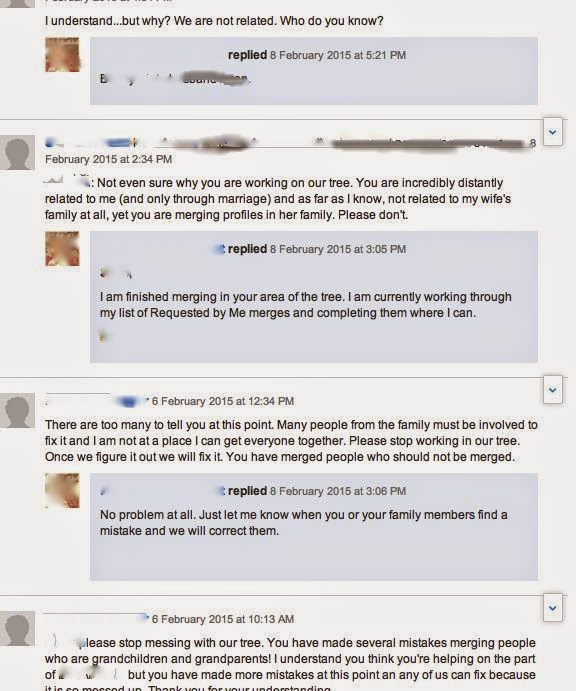
This morning after a minor disaster doing my time-lines, I went to Geni to double-check some information that I hadn't stored at Ancestry.  On my home-page was a long list of "merges", that is, blending profiles from different researchers.  It didn't really affect me because it concerned the immediate family of the second cousin who had issued me the invitation to Geni, but two things made me enormously uncomfortable:
1)  With one exception, the merges concerned living relatives;
2)  I didn't  recognize the name of the person doing the merging.

Above, I've taken steps so you won't recognize any names either. It's from the home page of the "merger" which I had immediately checked.  It turns out I'm not the only one who doesn't know who he is and is not okay with his "fixing" other people's family trees.  You'll also see that he is very unperturbed.  He says he is a volunteer Geni "curator" whose job it is to merge as many trees into the "World Family Tree" as possible.

I'm not getting into the pros and cons of "collaborative trees" here.  There are plenty of impassioned arguments going on in the comments sections of popular genealogy blogs and web sites.  Suffice it to say, I double-checked my privacy settings, all set to the maximum that Geni will allow, and discovered that Geni staff can go into any profile they please.  Our friend above said, in response to yet another exasperated request that he stop putting his oar in, that as a "curator", he has "special privileges".

That was enough for me.  I went straight to my Geni tree and set to work feverishly, first deleting my daughters' profiles which are supposed to be visible to family only.  As I worked through the morning, I discovered that if I deleted profiles in a certain order, that is, children, spouses, then siblings, then I could usually delete the profiles in my direct line.  When I couldn't, I went directly to the profile, and  sometimes could choose "delete"from the Actions menu.  Failing that, I used my old trick of manually erasing all information from the profile itself, using the "edit" tab.  Once that was done, I found I could delete those profiles as well.

By late afternoon, I had cleared my side of the tree to my name only, and the vast majority of the Resident Fan Boy's paternal relatives.  I'm leaving the RFB's maternal ancestors because, as I've said, it was those cousins who invited me in the first place.  Besides, they're usually the managers of those profiles, so I couldn't delete them anyway. (I can't delete my husband or his immediate family because other cousin manage their profiles, for example.)

For good measure, I went into my photo file at Geni, and deleted all photos of living relatives and my own deceased ancestors.

I will now wait and see if I get another snippy message.  If so, I will complete the job and close my account.

You can lecture me all you want about collaboration, Geni.  Cooperation still doesn't mean co-opting other people's work -- particularly without their permission.

Monday, 29 December 2014

Someone has my number

I follow Twisted Twigs on Gnarled Branches on Facebook with a horrified fascination.  

She gets a little too close for comfort on a regular basis.

This also gives you a clue to why I have little in the way of a post today.

Saturday, 27 December 2014

Not for the faint of heart

My husband has a German last name, inherited from his very English father, an Anglican archdeacon. His grandfather had a German forename as well, hastily anglicized during his service in the Royal Naval Reserve during the First World War, although he could speak German, having been tutored by his Berlin-born paternal aunt.

When I submitted my husband's DNA for testing about two years ago,  I felt sure that we might find out more through the Y-chromosome testing.  However, not a single instance of his surname showed up on the matches.  What was clear, though, was something we've long suspected: 14% of his genetic make-up comes out as Jewish - Ashkenazi, to be precise, with possible national connections to Poland, Ukraine, Lithuania.  Also, despite the relatively small percentage of his total DNA, the vast majority of his matches at the Family Tree DNA website, both for Y-chromosome and autosomal,  appear to be American Jews.

With no surname match, things went a little dead in the water - until about a month ago, when his surname turned up in the family tree of a recent autosomal match with connections to Berlin and Poznan. The latter city is currently in Poland, but has links to Germany.  I wrote a quick email to the American who had submitted his DNA.  He told us that he had a cousin living a few miles away in his home state of California who shared the Resident Fan Boy's surname and that this cousin would be taking the Y-DNA test soon.

So we wait.  If this cousin shows up in the Resident Fan Boy's Y-DNA matches, we will have a better idea of where his paternal line goes.  If not, it's back to the drawing board, though I'm anticipating an autosomal match at least.

There is a painful side effect and it's one I've long been expecting.  In the family tree of the man with the autosomal match are, as I've said, several members bearing my husband's surname. They are in the line of this man's paternal grandmother.  With a sinking heart, I noticed there are families whose death dates are all in the early 1940s.  When I clicked on the profiles, I saw the words: "Auschwitz" and "Theresianstadt".

Yes, I knew this would happen eventually, but all the intellectual preparation in the world doesn't lessen the blow of seeing the names of people with the same last name as my husband and children, knowing how they died, and knowing that, somehow, they are ours.

Thursday, 25 September 2014

Holy father of. . .

What I wanted to write:

Dear Fellow Ancestry Member,

I have watched with horrified fascination over the past week as you have saved record after record that I have posted, from my family tree to yours.

Just one question.  How on earth do you think you are related to the people in your own tree, let alone those in mine?  

I hardly know where to start.  Don't you think it's odd that the great-great-great-grandfather you've assigned for your home person was, according to you, married seven times, and that four of those marriages are double marriages to his own sisters-in-law? Or that the 32 children you're claiming he fathered are mostly duplicates (mercifully) of nieces and nephews, and in a couple of cases, great-nieces and first cousins?

Sorry, that's three questions.

Let me tell you about the man you think is your ancestor.  He was blind from childhood and he taught music, played the organ, and tuned pianos.  How do I know this?  Because I have checked -- and this means I actually read -- each census between 1841 and 1891.  Do you know what else the censuses tell me?  No children.  None of those 32 children you have with them, a number with different surnames.  (Didn't that puzzle you?)

He married Sarah Mason in Islington in 1847.  She may have been his cousin; the Mason name appears in older generations.  She certainly wasn't his aunt, as you have indicated for the two Sarahs you claim he married.  The age difference might have been a clue to you.

I don't even want to get into the dog's breakfast of erroneous ancestors you've mixed up for him out of a hodgepodge of family trees you've borrowed from Ancestry.  I cringe, frankly, to see that you've listed my tree as a source.  Clearly, you have never looked at it. 

I would also like to point out that the grandfather you've assigned for your home person is highly unlikely to be related to you at all, so everything else is moot.  You claim he came to the States and married a Lillie Dubois in 1890.  I found him in the 1891 British census, living in Islington, London with his parents and siblings, and studying the law.  In 1901, he's still living with his parents who have moved to Surrey.  You've saved this record to your own tree.  Did you bother to read it? He's listed as a solicitor and he is single.  You have him as the father of  six children by then.

Eleven men named Frederick William Hales were born in England between 1845 and 1871 -- it is not an unusual name.  I am positive that the Frederick William Hales in your tree is not your ancestor.  I think you should remove the documents you have copied from my tree; it is a poor use of them and you are proving absolutely nothing.  

And I really wish you'd remove the reference for my tree.  You're embarrassing the hell out of me.

Despairingly, 

What I actually sent:

Dear (her name), 

You are, of course, free to ignore this.

I have noticed, with some interest, that you have been saving copies of various documents I have posted to my tree, connected with my great-great-grandfather, my great-great-great-grandparents  and their family.  I am somewhat dismayed to see them attached to the wrong people, especially since I am sure you would like your tree to have your real ancestors in it!

I can tell you that the Frederick William Hales and his ancestors -- at least as you have placed them on your tree -- cannot possibly be related to you.

Will you permit me to tell you why?

You say your ancestor Frederick William Hales, the father of William Nallard Hales, married Lillie Dubois in 1890 and fathered eight children during the following 16 years.  My third cousin twice removed Frederick William Hales (who is the grand-nephew of my great-great-great-grandparents, not their grandson as you have in your tree) was living with his parents at the time of both the 1891 British census and the 1901 British census, where he is clearly noted as being a solicitor and and single.  In 1903, he was a godfather to the son of his eldest sister Edith Eliza Seymour (née Hales) at a christening at St Andrew Alexandra Park in north London.  He married Margaret Evelyn Rawson at the very same church in 1920.  He is noted as a 51-year-old bachelor - not a widower. 

None of this fits with the details you have provided about your ancestor who is clearly another Frederick William Hales.  This means, I'm afraid, that none of the ancestors, uncles, aunts, and cousins that you have for your Frederick William Hales, nor the documents you have attached,  belong in your tree. There were eleven men named Frederick William Hales born in England between 1845 and 1871.  I'm sure, with some research and detective work, you can find your true ancestor, the Frederick William Hales who belongs on your tree, and learn his story.  Have you considered joining a family history society?  They could be of tremendous help to you.

Sincerely, 

See?  This is why I need to wait three days before trying to correct someone on the internet.  She may get ticked off with me anyway, but I, at least, think I don't sound as angry in the second draft.

Thursday, 1 August 2013

An odd sort of joy

Last December, I blogged about the discovery of a great-great-aunt-by-marriage buried in the churchyard where my late in-laws' ashes are interred. (This is only extraordinary if you know that both my husband's family and mine came to Victoria many years after said great-great-aunt's demise.)

At that time, the Resident Fan Boy decided that we should schedule a churchyard visit on the date of his parents' wedding anniversary. Today was the day and we escorted a resigned younger daughter up Cedar Hill, stopping only to pluck some early ripening blackberries above the sloping sidewalk.

We know where the RFB's parents are; there's a particularly embarrassing story surrounding my late mother-in-law's interment, so the RFB and I searched rows of more ancient graves, splitting the task while younger daughter wandered dreamily up and down the dusty rows of headstones and watched a young family of deer retreat ahead of us, nibbling.

This was my very first graveyard search as a family researcher -- the vast majority of graveyards I need to search are in Great Britain -- and I didn't have high hopes of finding the tomb in question, noticing quite a few stones were illegible. However, in less than ten minutes, the name appeared at my feet and with it, the difficult-to-explain surge of joy that assails the family researcher. I feel a version of it every time I find a confirming record, but to the uninitiated, it may have seemed rather morbid to hear my gleeful whoop.

Seasoned genealogists will understand. It's more than finding a name. It's the odd sensation of reclaiming a family member. This aunt, not even a blood relative, died long before I was born. I know little of her aside from her dates of birth, marriage and death, and the names of her children. In a way, it's better. I have no judgements to offer on her life or her personality, only the feeling that she has been acknowledged, that someone remembers her place in my family.

Today, I was able to stand at an ancient burial place and say, "Welcome back, Auntie Ellen." It's an odd joy, but I'm taking any joy on offer.

Thursday, 6 June 2013

Geni out of the bottle

As much as I enjoy family research, I must admit that it is rife with hazards.  I have discussed quite a few of them on this blog before:  You can make fascinating discoveries -- which may not be appreciated as such by other family members.  You may find your work co-opted by others, and used in ways you never intended. There's a possibility you will contacted by people you'd rather not meet.

Then there are the many companies springing up to aid -- and profit from -- the dedication, desperation, and quite frankly, the addiction of family researchers.  I'm not saying they're evil incarnate, y'understand, but every budding family researcher (and a few of past-their-first-bloom ones) needs to understand that these companies are in it for the money, which means they may not explain all the implications of their systems to you.  Or the implications simply may not occur to you.  By which I mean "me".

I have three family trees online, mainly as buffers against computer catastrophe.  Should my PC go "foom", as it has from time to time,  quite a bit of my research is stored at three different sites.  The latest site where I established a repository of my family research is Geni.com, and I did so at the invitation of one of my husband's second cousins, who hasn't done much research himself, but knew I had.  It seemed a good opportunity to share what I had with a particular branch of the Resident Fan Boy's family.  Besides, some of what they were posting wasn't quite accurate; misspelled names, wrong birth-dates and birth-places, that sort of thing.

My original intent was to limit my Geni contributions to that branch of the family only, but if you've been paying attention, I've mentioned dedication, desperation, and addiction -- and that's just me being nice.  Over time, I simply couldn't resist filling in other branches of the family as well, including my own.

Well, predictably, Geni started charging for their family trees about a year ago.  Unless you upgraded, you could no longer add relatives.  This must have gone over like a lead balloon, because recently, so-called "basic" members (the non-paying ones) were once again allowed to add information to the trees, while certain aspects, such as merging trees or making contacts with strangers with shared ancestors, were restricted to so-called "Pro" members.  Since merging my tree had never been an attraction, I didn't pay much attention.  In fact, I only updated the tree when I had something new and startling for the Resident Fan Boy's cousins.

I had taken some privacy precautions, making sure that the relatives I entered were on the setting which permitted their being viewed only by close relatives by genealogy standards, no further out than third cousins.  I had noticed that with certain ancestors, I didn't have that option, signaled by an icon of a globe at the top of their profile.  These all seemed to be great-great-great-great-grandparents and associated family, so I wasn't particularly worried.  Until last week.

When you enter a relative into the Geni format, you become the "manager" of that relative.  If someone else wants to manage, that is, edit information on that particular relative, they usually have to make a merge request.  I've been working on time-lines this month, and as a result have acquired more information, so went to my online trees to update.  To my horror, I discovered that I now had "co-managers" on a pair of my 4xgreat-grandparents; two strangers were claiming to also be descendants of this pair.  Apparently, if a profile is public, then no merge request need be made.  This means that any Geni member who believes this person is their relative can enter their own information in their preferred format, and that is how it will appear in "your" online tree.

Now,  I have no reason to doubt that these two gentlemen are also descendants of my gggg-grandparents, nor do I have a problem with sharing information.  I do have a problem with its being foisted upon me. I sought to rectify the problem by dismantling those branches of the family tree which go back further than 4xgreat-grandparents.  You do this by deleting individual relatives, using the "x" in the upper right hand corner of their square.  You can see the crosses on Harry Potter's parents in the illustration.  One problem: not all squares have crosses.  I was able to delete my great-great-great-great-grandfather, but not my 4xg-grandmother.  I couldn't even delete their daughter, in order to excise that branch of the tree. Looking further along the branches, I could see that some squares had the delete option, others not.  You could take out some siblings and spouses but not others.  If there was a rule for deletion, it escaped me.

Another wrinkle emerged within a few hours.  One of my co-managers contacted me, politely asking why I had deleted our joint 4xgreat-grandfather.  Had I meant to?  I tried to explain my reservations in the most diplomatic way possible, considering how unnerved I was.  I told him I would be pleased to share family research with him, but I had no "urge to merge", and had failed to understand that I didn't have a choice in the matter. I also told him that I saw no reason that he couldn't simply re-enter the ancestor into his tree.  So he did.  And damn it!  I re-appeared as co-manager! I hasten to add, that I don't believe this is his fault -- I don't think he has much in the way of options either.

So, in short, if you're considering joining a Geni family tree network, be warned:  once you've entered a person, you may not be able to remove him/her.  You may resign from Geni, but your tree will not resign with you.  You can dismantle or even delete your trees at Genes Reunited or Ancestry, or make them entirely private; this is not an option at Geni.com, and I suspect it's a similar story at myheritage.com which has a very similar set-up and is, I believe, affiliated with Geni.

I've worked my way out to the furthest reaches of my Geni tree (which, I suppose, isn't even mine anymore), deleting anyone with a cross in the square, leaving scores of others which I am unable to delete, open to being co-opted by other "managers".  I suppose I could erase the information in the in-deletable fields, leaving abandoned pink and blue squares hanging in cyberspace, waiting to be filled by others with the same (or possibly wrong) details.

Once again, Persephone learns.  The hard way.  Always the hard way.

Friday, 8 March 2013

Ranting about relatives, rape and "nonpaternal events"

Today is International Women's Day and at John Reid's indispensable blog Anglo-Celtic Connections there are links to genealogical tweets.  This morning, I happened to follow a link on one to this article by Belinda Griffiths at Ancestry.co.uk about tracing women on family trees .

Now, finding your female ancestors is always a challenge.  I've just had a major, family-tree-shaking breakthrough involving the discovery, after ten frustrating years, of the will of my great-great-great-great-grandmother, which reveals, among many other things, that two women whom I thought belonged elsewhere are actually her daughters and thus my 4xgreat-aunts.  I've been madly re-shuffling relatives and emailing fellow family researchers who share those particular ancestors.

The reason I had so much trouble finding my gggg-grandmother is that she was widowed four times.  Her first husband was my gggg-grandfather and the sire of all her children.  Her third husband was another of my great-great-great-great-grandfathers, resulting in my 3xgreat-grandparents being step-siblings (the subject of my previous post -- it's been a startling week!).

However, Ms Griffiths' article -- and I know I really should use more refined language -- pisses me off.

Ms Griffiths titters about cuckolded husbands wondering whether they were bringing up another man’s child or children. .  . .  Show me a family historian who can put his or her hand on heart and swear that there has never been in their family tree any instance of what the DNA experts call a non-paternity event and I will show you either a fibber or a gullible optimist!

I've recently had both the Resident Fan Boy's and my DNA tested, so have been attending information meetings about the use of DNA in family research.  I encountered a similar attitude there, a lot of chuckling about the possibility of what at least one DNA research company openly calls "infidelity".

To the smirking men at the DNA interest meeting and the tittering Ms Griffiths, I long to ask:  Is it "infidelity" when the woman had no choice?  Do you really think your foremothers had much control in their so-called sex lives?

 I'm in the midst of Ian Mortimer's  The Time Traveller's Guide to Elizabethan England. In a chapter entitled "Basic Essentials", he mentions in passing:
Young women also often have to put up with the unwanted sexual attention of their masters; it seems to be accepted that a master will normally have sex with his female servants. . . .To be a young woman in service is thus a double predicament.  To refuse your master is likely to result in dismissal; but to give in is to risk disease and pregnancy, as well as dismissal when the pregnancy is discovered.

I don't know about you, but I had several female ancestors in service.  I don't think the situation had changed that much in Victorian England, and, a century after that,  Peggy Seeger's musical diatribe "Gonna Be an Engineer" (written about 1970, I think) featured the lyric: It's the duty of the staff for to give the boss a whirl.  So, if you needed the job badly enough (and you usually did), you did what you had to do -- and if a baby resulted, well, it was your fault, of course.

And what about my four-times-married, four-times-great-grandmother?  Did she marry out of choice?  She was a wealthy woman.  It appears that she and two of her sisters married three brothers.  That smacks of economics to me, and I'll bet her three subsequent marriages were more pragmatic than romantic. In a world (not so very distant) where women didn't vote, didn't have legal status as persons, could easily be relieved of access to their children, a woman taking a lover in such a world would have been risking everything.

In short, I don't think wealthy women nor poor women had much right to say "no".  So I ask the amused Ms Griffiths and the chuckling gentlemen at my DNA information meeting to consider that their many-times-great-grandfather may not have been gullible.  He may have been protecting your many-times-great-grandmother by giving her child, conceived under duress, his name. It's not amusing to think about, but I think it happened more often than we care to admit.

I think in doing family research, we uncover many human failings, but -- especially on International Women's Day -- let's acknowledge what a very hard row our fore-mothers had to hoe, and how many millions of women today have little choice in what happens to their bodies.

If you suspect your family line has its genesis in a female ancestor's "infidelity", let's hope to heaven she had some say in the matter. And let's lose the smirk, shall we?

Thursday, 28 February 2013

A genealogical jolt

Outside, the snow is clinging to the branches of the tree like blobs of meringue.  You can hear the occasional soggy plop as a cold, wet ball gives into gravity.  I've been on the receiving end a couple of times over the past thirty-six hours.  They're heavier than you think and your shoulders jolt upwards as the snowball bears down.

I've had a genealogical jolt today.  I've been working my way through the London Electoral Registers (1832-1965), checking which of my London ancestors had enough property to vote in the nineteenth century.  An odd pang of pride has been the appearance of the names of two of my great-grandmothers and a couple of those of the Resident Fan Boy as suffrage was extended to "selected women over 30" in 1918.

However, as is the usual case, my checking through the data has led to a re-examination of some parish records -- and to the discovery of a third marriage for one of my great-great-great-great-grandmothers and the realization that this third marriage was to another great-great-great-great-grandfather.  That is, a different 4xgreat-grandfather than the one she married the first time.

Which seems to indicate that a pair of my great-great-great-grandparents were step-siblings.

As far as I can tell, this wasn't illegal in 1813 and isn't illegal now.  They didn't even grow up together, as their respective parents were well into middle age when they found each other.

Still, it's a bit like a thick wet smack on the top of my head.

Friday, 25 January 2013

Someone is WRONG on the internet

One of my distant cousins (well, she's something like my second cousin once removed which, in family research terms, is practically immediate family) just sent me an email apologizing for a flippant comment she had made about two babies in our mutual branch of the family tree who died "of teething". She said her comment was insensitive. Now, seeing as these babies died well over a hundred years ago, I thought they were well beyond hurt feelings, and told her as much, adding that steering around the sensitivities of the living is far more perilous, speaking from sad experience.

I must admit though, if I were as scrupulous as my cousin, I'd probably have smoother sailing online.

I've always thought of myself as a tactful person, but then everyone thinks s/he is a good driver, or has a sense of humour, so I may be deluding myself. Especially considering I don't drive. I can also think of way too many occasions where I either put my foot in my mouth or was simply misunderstood. Online, the opportunities for inadvertently pushing someone else's buttons seem to quadruple, no matter how meticulous the proofreading. Sometimes, all the emoticons in the world cannot save you. (Granted, there's compelling evidence that I shouldn't be allowed anywhere near emoticons.)

The area of family research is particularly sensitive, because, not only are you dealing with dead family members, but you are addressing people who feel deeply proprietary about said family members. I include myself in this feeling, you understand. It has gotten me into trouble more than once.

I have a public tree at Ancestry.co.uk. Now right there, we have a controversy, because there are family researchers who will tell you that it is foolhardy to have a public tree. I can see what they mean. Over the ten or so years I've been researching my family online, I've seen more and more people simply copy down the information off others' trees, without a word to the original researchers. I blame ads such as this one from Ancestry.ca: We'll do the searching for you.
You don't have to know what you're looking for...

Right. It turns out there are a lot of people out there who not only don't know what they're looking for, they don't know how to look for it. They seem to have no concept of research protocols, such as looking for evidence in more than one place, or noting where they got their information. With little idea of geography or history, they make assumptions and their family trees are full of other people's relatives, not their own. For some reason, the ads don't mention this.

There's no doubt that my public tree has resulted in stunning finds and wonderful connections. I'm loath to give it up. It's a bit too late anyway as scores of people have made off with my research and what's worse, my family photographs. Ancestry, of course, encourages you to add family photos, with a gentle warning not to post pictures of living people. Quite right, too. What they don't tell you is that other "researchers" will copy your photos to their trees. I wouldn't mind so much if these people were actually related to me, but I've checked, (it's not hard) and nine times out of ten, they've made a fatal error in their direct line. For example, there was the case of a woman in Ontario who had been painstakingly copying down everything in my tree. I'd make entries, within a day the data appeared on her account. (Ancestry notifies you when records you've saved are saved to another tree.)

I checked and quickly saw that she was claiming one of my great-great-great-aunts as her great-great-grandmother, despite the fact that her g-g-grandmother was born forty miles from the birthplace of my g-g-g-aunt, in a different year, and they had married different people.

As a matter of fact, I'd been in touch with her before on another issue, asking why she had my great-great-great-grandmother married to both my great-great-great-grandfather and his brother, having children well after her death. Pleasantly -- and predictably, she said she'd got it from another tree. I was reluctant to contact her again; besides, I have this rule for myself that I don't intervene with someone's research unless it involves one of my people in my direct line. (Otherwise, I'd be intervening all the time; the problem is that prevalent.) I watched for weeks as she added people, photos, and records from my tree to hers. The final straw came when she posted my late father's address from the nineties, a condo where his widow still resides. This was around Christmas Day and I made myself wait three days before sending a carefully-worded email a) pointing out that my father was entirely unrelated to her; b) laying out the evidence for my great-great-great-aunt not being the same person as her g-g-grandmother; and c) adding, a little unfairly, that my stepmother had had an unwelcome contact since her address had appeared in this woman's tree. (This was true, but I doubt the interloper had got the information from Ancestry.) I got a very apologetic message with the promise to dismantle that part of her tree. It's still up there, but my late father's address is gone.

So that worked out quite well. Within a few weeks, trouble came from another quarter. A lady in Australia was posting photos of some of my ancestors. That's not awful in itself, what usually happens is that a note will automatically appear on that person's tree stating who the original submitter was, along with any information about the photo that the original submitter included. This woman had copied the pictures to her computer, re-labelled them and posted them again, without the accompanying information. I knew this because, as these people are my ancestors, "her" pictures turned up in my list of possible leads. (These weren't pictures of her ancestors, by the way. My great-great-grandparents are her husband's distant cousins, not even in his direct line.)

I didn't wait three days before contacting her. I should have.

I was pretty damn mad and even through I tried to establish a tone of polite bewilderment, I probably came across as angry. (Gee, d'you think, Persephone?) I said that copying photos and re-submitting them as her own defeated the spirit of family research and that this was one of the reasons I no longer share my photos on Ancestry. At first glance, her response seemed quite charming. She explained that due to broadband limitations, she preferred to transfer photos to her own computer, that she derived great pleasure from sharing selectively photos that "gave faces to" relatives, and that she was sorry I would no longer be sharing photos because my tree was "wonderful". She rather spoiled the treacly stuff by apologising "if" I were offended. (Using the conditional tends to negate an apology; it suggests that somehow you aren't, or shouldn't be, upset.) She also put "copying photos and re-submitting them as mine" all in capitals, effectively shouting at me.

I replied that asking permission before posting other people's photos is not required, but that it is courteous, and she could consider at least giving credit to the relative who had carefully restored and digitalized the photographs. I also couldn't resist adding that the idea of her "selectively sharing" photos with strangers didn't give me much comfort.

You can probably guess what happened.

The return message was very short. She was deleting my photos, she said. Consider myself blocked, she said. Oh thank goodness, I thought. I was just on the verge of blocking you.

Sigh. What have I learned from this? Probably nothing I didn't really know already.

First off, and probably most important: I succumbed to the siren call of correcting someone who is wrong on the internet. This has been stated in beautiful simplicity by this xkcd web comic classic, entitled "Duty Calls" by Randall Munroe:

If someone has made an error in fact, judgment, taste, etc., and I'm falling over myself to set them straight within the next few minutes, I should stop myself. In this case, I should have waited three days for before posting each response.

I still believe she was wrong. Not in a legal way, of course, once I'd posted those photos, they belonged to the world, and I won't be posting ancestral photos on Ancestry again. In terms of research, courtesy, and the plain old Golden Rule, she was mistaken. However, I didn't fare so well in the Golden Rule department myself. I was too angry. Simple as that.

Wednesday, 12 December 2012

In passing

I'm trying to get ready for Christmas. I really am. This probably means I should stop checking John Reid's blog Anglo-Celtic Connections. This time, he was passing on a tip about links to birth, marriage and death registrations at the Royal British Columbia Museum web site.

So, instead of addressing more Christmas cards and getting my parcel to Victoria ready to mail, I was diving into the registrations of the handful of relatives I know to have BC connections. What did I discover? Well, for one thing, BC marriage and death registrations are very detailed, particularly the death registrations: place of death, last address, every physical malady that contributed to the death and how long they were sick, names of parents, spouse, what they worked as and for how long, length of time in British Columbia... I found out that the reason I've been having trouble chasing down one cousin is that she had a radically different middle name than the one I had in my records, and her funeral was held where my sister was married. I learned that her sister was married in Christ Church Cathedral in 1910. Christ Church Cathedral is just up the hill from our last home in Victoria. Younger daughter was christened there. Elder daughter went to Sunday School there. The Resident Fan Boy's father's funeral service was held there.

So much for yesterday.

This morning, I still couldn't leave it alone. Family research is a disease, didn't I tell you? I remembered hearing that my great-great-aunt by marriage emigrated to Canada with her daughters. Within a few minutes, I had the details of her death before me.

I've walked past the graves in the churchyard at St Luke's in Victoria several times. I caught my first glimpse of the Resident Fan Boy at a wedding there, months before I met him. His sister was married there. His parents' ashes are interred there. I never guessed that I was passing the grave of a member of my own family, buried on a September's day in 1947.

When I told the Resident Fan Boy about this, he told me that his parents will have a significant wedding anniversary this year and he'd like to visit their graves when we're in Victoria next summer. I'll slip in among the older graves and see if I can find my grandmother's aunt. I wish my gran had known she was there.

One of the main reasons I got into family history was that, as a first generation Canadian, I didn't have a strong feeling of my family's past until I visited England for the first time. How ironic that distant and rather lateral aspects of it were lurking in places I strolled by daily.

I've finished packing the parcel and have written one more card. I'll get it all done, especially if I stay away from John Reid's blog.

Thursday, 22 November 2012

The light is dark enough

This morning, I checked in at John Reid's Anglo-Celtic Connections, which is always a mistake when I have other things that need doing. He provided links to two historical Wolverhampton blogs which are new to me. One is focusing on the impact of the First World War on the city. It certainly had an impact on my family: my great-aunt died in the influenza epidemic that came home with returning soldiers, and my great-uncle committed suicide in the 1930s, partly due to his physical, mental, and emotional war wounds. The other blog provides, among other things, pictorial tours of various areas of the Black Country, of which Wolverhampton forms a part.

And I stumbled upon this 1795 painting by one Joseph Mallord William Turner, aged about twenty at the time. JMW Turner became famous for his later paintings, masses of light, paintings in which it is difficult to pick out the subject because by that time, the light was the subject. Demeter has always loved those later works; she has a print of The Fighting Téméraire in her living room, which she can't see right now because she's recovering from an eye procedure and must sit in the dark for 48 hours.

So I must wait to share this with the great-great-great-granddaughter of John Meanley of Wolverhampton, an innkeeper in Snow Hill who took the first of his ten children to be christened, possibly making his way through this market place toward the imposing tower of St Peter's Collegiate, the morning of January 3rd, 1796. I wonder if he, his parents (who also married at St Peter's), his siblings or his wife ever brushed by a young man in the city the previous year, sketching this view while facing north where Queen's Square meets Lichfield Road. At any rate, this is something they must have seen almost every market day, and being the Black Country, I doubt the light was the subject of anything.