Showing posts with label family history. Show all posts

Monday, 11 May 2026

Share and share unlike

For the first couple of decades of our respective lives, Double Leo Sister and I were so unalike, and so seldom seen together, that many people mildly acquainted with us were unaware that we were related.  

This has changed steadily as we have aged and we're pretty similar now - at least in appearance and mannerisms, if nothing else.  

About five weeks ago, in the wake of our mother's death, I handed an Ancestry DNA kit to my sister.

Shortly afterwards, she managed to break her humerus and tear her rotator cuff. (This was just what happened, not cause-and-effect.) 

At any rate, I was pretty sure she had forgotten all about the test, and was preparing to remind her when she was down-Island, that if she really wasn't interested, she should give the kit back, because it's pretty damn expensive.

No, she said, she'd tested and furthermore, had heard back weeks ago.

No sign of her in my DNA matches, nor in those of my mother, whom I tested five years ago. 

You're thinking of all those stories, aren't you?  Those news items about people getting a DNA kit for Christmas and discovering, with a shock, that they're not related by blood to those they grew up with?

We should be so lucky. (I'm joking, but I think it crossed both our minds.)

Apparently, Ancestry now requires you to turn on match-sharing before it becomes visible to your matches, which, I guess, is a good idea, but it makes me wonder how many other matches I'm not seeing, because it's clear that most people take the tests to get the nebulous ethnicity estimate  --"estimate" essentially means "guess", people -- and don't bother with the matches at all.

Anyway, my brother-in-law, the Jolly Not-So-Green Giant, figured out what icon to switch, and there she was:  "Full Sister" - a slightly lower number on the centiMorgans she shares with Demeter, with nearly twice the segments that I have in the DNA match with Demeter.  Also, her ethnicity estimate is quite different than mine, which happens to be way more similar to my mother's - interesting, but in the long-run, not that significant.  Double Leo Sister has clearly inherited a different set of DNA from our shared ancestors; that's how DNA works -- it's more random that you might think.

Have I lost you yet?

I tried to talk about all this with my sister and brother-in-law, but like most people, they're really not into family history research, and they soon changed the subject. My sister is into Creative Anachronism and stained glass.  My brother-in-law is into computers and fantasy novels.  I'm not crazy about any of that.

I let them chat about these things with the Resident Fan Boy, while I started using my sister's shared matches to identify even more of our mother's and my shared matches.  

They went home early.

Friday, 28 February 2025

And then who the hell was I?

I can't understand why I am exposing us all in this way . . . . Is this the tsunami that she unleashed when she went, and all of us still flailing in her wake, trying to put her together in the wreckage, and her slipping away, over and over, just as we begin to see her face? - Sarah Polley, in an email to her father Michael Polley

Looking to see what family connections there possibly could be connected to me and enjoy building hopefully a happy picture - From the profile of a recent DNA match to the Resident Fan Boy

Stories We Tell has that quality shared by all of my favourite films: the ability to draw me back, again and again, noticing new details every time; being a completely different movie every damn time.

The subject is the gradual revelation of a family scandal, and how widely the narrative varies: from those directly involved, to the those affected by it, to those who witnessed aspects of it.

We tend to screen books, music, and movies through our own uppermost concerns, so my first viewing of Stories We Tell, about ten years ago, reminded me of the myth-making and myth-busting of family research and the resulting clashes of narratives and identity.  More personally, I had a similar, but not identical, revelation in my own family at almost the same time, resulting in everyone affected having to rewrite their own family story.  I think few amateur genealogists fully appreciate the risks of their research, but this risk applies to anyone setting out to tell the story of their relatives.

Our changes in perception are constantly evolving, so a few months ago, I re-watched the film following the tsunami in the wake of the death of Alice Munro, the Nobel Prize-winning author who died last spring. The figurative family bombshell that hit Sarah Polley's family about a decade and a half after the death of their matriarch is not of the legacy-tarnishing quality as that affecting the Munro family, but it was also deliberately kept out of the papers, initially to protect Michael Polley, Sarah's father, and then, because this documentary was being made.

Sarah Polley in the 1980s with parents Michael and Diane

Diane Polley, an actor and casting director, died in 1990, when Sarah Polley, then a busy child actor and now an award-winning writer, was eleven.  Diane had four older children:  John and Suzy Buchan, from her first marriage, and Mark and Joanna Polley, from her second marriage.  They all take their seats at the beginning of the film, like a family gathering at an intervention - except none of them are in the same room; this is footage from separate interviews, during which Sarah Polley asked each to "tell the whole story, from the beginning", as if to someone who is hearing it for the first time.  The backing music is "Skinny Love" by Bon Iver:  And I told you to be balanced/ And I told you to be kind....  

And the late Diane Polley also seems to take her place as well, via footage of an audition from the mid sixties.  But she doesn't say a word.

Someone who doesn't take a seat is Sarah Polley herself, who deliberately keeps silent through most of the film, aside from the occasional question or brief comment, and appears in the occasional re-enactment of events, but with no soundtrack. Sometimes this makes her presence seem oddly impassive, but, as her father astutely points out, she has the ultimate control over what makes it into the film.

Here, I must alert you to spoilers, if you're planning on watching this movie -- and you should.

Polley moves back and forth in time, revealing the surprises and twists out of sequence, but closer to the timeline of their discovery.  She illustrates events with authentic family movies and (*first spoiler*) reconstructed Super 8 footage, using actors.  The Resident Fan Boy didn't notice the latter, but I did, mainly because I recognised Rebecca Jenkins, a friend of Diane's, an actor who also sang back-up for Jane Siberry in the eighties.

Polley is careful to illustrate the differences in  the many narratives about (*big* spoiler) finding out the identity of her birth father. The stories are similar, but vary in small, but important, details, revealing, in particular, the biases of her father, actor Michael Polley, and her birth father, producer/writer Harry Gulkin.  At one point, Gulkin tells Sarah, with some intensity, that the story belongs to him, because he's the one surviving person who experienced it directly.  (I have to restrain myself from shouting at the screen every damn time - if the story belongs to anyone, it's Sarah Polley herself.)

One of Polley's greatest assets is the thoughtful articulateness of her interviewees, particularly her siblings, all evidently very bright people with greater comfort in front of a camera than most people.  It's particularly fun when her brothers give her a hard time, in the way that big brothers do.

Close to the end, we have another moving montage of the storytellers, this time to "Demon Host" by Timber/Timbre: All those messages you sent, clear as day/ But in the night, oh, I couldn't get it right.... The camera lingers on each bereft face: Diane's grown children, her husband, her lover, her friends, her brother.  Years later, she is clearly so missed.

Michael Polley and Harry Gulkin both died six years after the release of this film, within a few months of each other.

The unreliable narrator is a new concept for me, and I seem to be coming up against the term multiple times over the past few months.  (Don't know how I missed this while studying literature in university.) This film demonstrates that we are all unreliable narrators; human memory is just too malleable and mutable.

I think Harry Gulkin was mistaken.  The truth, while ever elusive, is closer through the mesh of narratives, rather than sticking to one voice -- even if that seems the more intelligible way.

But then, perhaps truth is never singular.

Monday, 3 October 2022

Get lost

Elder daughter lives in South Wimbledon. At least, that's what she keeps telling me.

However, when I check Google Maps to place stories she tells me about her neighbourhood, it appears to be Merton. I don't like conflict, but I do like to be accurate.

Part of this is because I'm a family historian, and it's important to get place-names right.  Take a few weeks ago, when I was trying to convince a guy who has "manages" the grave of one of the Resident Fan Boy's distant cousins, that he had the wrong birth registration, and that the said cousin was born in Kensington, not Suffolk.

After some polite wrangling, my documentation convinced him, and I went to fill in the correct birthplace at Find A Grave, only to find that the only option that the automatic field would accept was "The Royal Borough of Kensington and Chelsea" - which didn't exist when the said cousin was born a century and a half ago.

See, London has gone through many administrative changes in its long history, and the confusion isn't mitigated by the fact that many versions of the geographical, political, municipal districts/boroughs/what-have-you continue to co-exist.  Some disentangling is in order.
This is not a bad place to start. It's one of many, many videos created by Jay Foreman, on the many, mystifying aspects of the organization of London, and, indeed what is, and is not London. The videos have high production values, and are hilarious.  You also need to keep your finger on the pause button, because there are several jokes that appear in a flash. His latest YouTube video is tackling Tube maps.  You have to be very witty to make that sort of thing engaging -- and Foreman and his team are.  Even the ads at the end are funny.

But what if you have concerns beyond London? For example, my mother was born in Wolverhampton, Staffordshire, but many websites will only permit me to say that she was born in Wolverhampton, West Midlands.  
This "Map Men" video, presented by the afore-mentioned Jay Foreman, plus Mark Cooper-Jones, doesn't solve my fillable fields problem, but is a damn entertaining intro to the crazy world of English counties - and whatever happened to Huntingdonshire and Rutland.

And if your geography problems are global (and whose aren't?), the Map Men can distract you from those too.
All clear, then? Good.

Saturday, 1 October 2022

Cutting it fine

The Tea Table (1920) - Harold Harvey

I had a pretty lousy night last night, and found myself blearily scrolling through social media early this morning, having tried, unsuccessfully, to get back to sleep.

This was how I stumbled upon this tweet from journalist and art historian Richard Morris, asking for feedback from his followers on the practice of buttering the bread loaf before slicing it.  It seems that he was aware of the practice (it's mentioned in Charles Dickens' Great Expectations), but thought it might have been a more local tradition, limited, perhaps, to the West Country, where he had documentation.

Wha-a-a??  I said to myself (silently, so as not to disturb the Resident Fan Boy -- which was damned nice of me, considering that it was his snoring that was partially responsible for my sleep deprivation).

First off, it's not that clear from the painting how this buttering was managed.  Fortunately, Morris got hundreds of replies, which you can read if you follow the link.  The followers writing in were remembering mums and grans from all over Britain, but especially the West Country -- and Wales. Many said that it was for economy; the butter made it easier to slice the bread thinly, and that today's bread, made by the Chorleywood method, would fall to pieces, if buttered or sliced in such a way.

I quizzed Demeter when I went over to set up her lunch.  She didn't remember her Welsh grandmother or her Wolverhampton grandmother buttering a loaf in that fashion, but did say that the Welsh loaves were startling:  large with rounded tops.

I went home and questioned the Resident Fan Boy, because I wondered if the technique made it to Canada, and if his grandmother, a farmwife in Alberta, buttered the bread this way. Not only did he not recall the women in his family doing such a thing, but, damn his eyes, he refused to believe such a thing was done!  Showing him the painting did not convince him, but when I had him read some of the Twitter replies, pulled up the passage from Great Expectations, and googled "buttering loaves before slicing", he came around.  (How very dare he!  He knows me well enough that I would have checked!)

I came to the sad conclusion that the generations of our respective families who would have known the answer have slid beyond our questions.  If yours haven't, ask -- and write it down.

Saturday, 24 September 2022

A dream of organising my ignorance

Yesterday morning, disturbing dreams propelled me out of the sleep into the news that Hilary Mantel had died.

My first reaction was a self-involved gut reaction:  Oh no!  No more books!

Social media was full of tributes, including this one on Twitter:

Evidence is always partial.  Facts are not truth, though they are part of it -- information is not knowledge.  And history is not the past -- it is the method we have evolved of organising our ignorance of the past.  It's the record of what's left on the record.  It's the plan of the positions taken, when we stop the dance to note them down.  It's what's left in the sieve when the centuries have run through it -- a few stones, scraps of writing, scraps of cloth.  It is no more "the past" than a birth certificate is a birth, or a script is a performance, or a map is a journey.  It's the multiplication of the evidence of fallible and biased witnesses, combined with incomplete accounts of actions not fully understood by the people who performed them.  It's no more than the best we can do, and often it falls short of that.

It was followed by "RIP Hilary Mantel".

Of course, no provenance given, and by the next morning, the person posting the tweet had, for whatever reason, removed the tweet. However I'm a family historian and this quote called to me as such, plus, my family history research has made me reasonably good at ferreting things out.

It's from Mantel's first BBC Reith Lecture.  It's long (because it's a lecture), but really worth following the link to read.

Mantel was discussing the historical novel versus "legitimate history".  She's been criticized (usually by male historians) of not being accurate, which is a strange charge to level at a novelist.  I don't recall Robert Graves being raked over the coals for I Claudius, nor Arthur Miller for The Crucible, nor Lin Manuel Miranda for Hamilton.  All three works take liberties with what is felt to have actually happened - and have won awards, despite this.

A family historian also wrestles with what Mantel calls our desperation "for the truth, and sometimes for a comforting illusion" - particularly with family members who, I often find, are only interested if the work I do confirms a family myth, and quickly drop the subject if it disproves it.

Mantel also speaks of coming from "a long line of nobodies" (something I've never believed of anyone). In the next few paragraphs, she demonstrates exactly the opposite, as she pieces together the life of one of her great grandmothers.  "Even nobodies can do this," she says self-deprecatingly with a strong whiff of disingenuousness.

So, no more books.  Or intriguing lectures.  If she had not written stuff down, we wouldn't have even that.
 
I'm determined to seek out more of what she left behind.

Quick update:  This morning, someone put the same quote up on Twitter, and someone else provided the audio link to the original lecture, which includes Mantel's other Reith lectures!  I may be a bit occupied this afternoon...

Monday, 5 September 2022

Missing the boat

The Sarmatian, of the Allen Line
Today, I came across one of those elusive discoveries that pleases family historians.

One of the Resident Fan Boy's great-great-great-uncles emigrated to Canada in May 1875, in the days when passenger ships had sails.  That's the ship he crossed the Atlantic in, just above.  It took nearly three weeks to reach Quebec City from Liverpool.  

Some months after settling in Stratford, Ontario, great-great-great-uncle wrote a very long letter to the Bury Free Press, back in his hometown of Bury St Edmunds, Suffolk, where his family had been reasonably prominent.

He gave his date of departure, the name of the ship, and spent several paragraphs detailing the rough seas and being slowed to a stop by icebergs.  Then he described the arrival, and journey through several Canadian towns and cities, followed by itemising local birds, animals, and plants.

Being a resident in Canada for seven months - it being late December at the time of writing - he was now an expert in Canadian life and requirements for immigrants.  No more room for "artizans", he declared, while conceding that a cutler was needed.  Immigrants should be young, and not encumbered by small children, if they were to take advantage of the opportunities of this new country.

Funny thing:  At age 45, he'd made the voyage with his wife, and five boys, ranging in ages eighteen months to 16.  In the whole of this epic, informative letter, he never mentioned any of them.

Tuesday, 19 October 2021

Listed but obsure

I was speaking yesterday of where my mind wanders while engaged in genealogical gate-keeping.  Sometimes I wind up in the company of long-dead great-aunts.

Inexperienced family researchers - I'm not claiming to be an expert genealogist, but I do have some experience - make the mistake of ignoring the "lateral" relatives, ie. aunts and uncles, especially those who, for whatever reason, didn't have children.

I can say to you without reservation, that childless aunts and uncles can be a goldmine to a family researcher.  They tend to take in struggling nieces and nephews, and mention them in wills, describing how they're related and who their parents are.

I'd like to tell you a bit about the Resident Fan Boy's great-aunt.  Up until a couple a weeks ago, I knew that she was born in Folkestone, Kent in 1878, and died in Montreal in 1948.  Brought up in the Church of England, she became the wife of a widowed Methodist minister (also British-born), who went on to become an advocate for prison reform in Canada, and was instrumental in promoting British immigration in Canada after the second World War.

About three years ago, I came across a scrapbook maintained by my late mother-in-law, which, by some miracle, had not been thrown away by the Resident Fan Boy.  It contained momentos of her various family members, particularly her aunts and uncles, and included a 1940s news clipping mentioning the great-aunt (in an article about her husband, of course), which mentioned her being a "well-known artist".

So it was, that a couple of weeks ago, my mind wandering, it occurred to me to try Googling.  I didn't have high hopes of a hit, but entered her full married name, and the word "artist". To my startlement and absolute delight, a website called worthpoint.com appeared, with a picture of one of her paintings!


It's an "oil on glass", painted in 1943. The website describes the great-aunt as "obscure but listed". (A bit of a comedown from "well-known" but it's been more than seventy years since she died.)  The web site does say she exhibited at the Art Association of Montreal in the 1930s, and sold a number of paintings, some for "a rather high price". Do I detect thinly veiled surprise?

Included are notes, apparently from the artist herself: "Kept 'lily' alive for a month in aspirin + water.frogs were in pond. Mr. Quesher, the curator, allowed me to take the lily from pond." (This was apparently at the Montreal Botanical Gardens.)

In a fit of excitement, I posted my findings on Facebook for the delight of the Resident Fan Boy's cousins -- and was met with polite approbation.

"Well, Mum," said elder daughter later, during our weekly Skype visit, "It's not like it was a fabulous painting..."  

And she was a long dead great-aunt, who had no kids, but judging from what little was said of her, mostly in relation to her husband, led a useful life of church work and social work, with a notable degree of creativity.  The last nibling with any memory of her died in 2013.

So I throw out a kind of lifeline, pulling these almost-forgotten women from the currents of passing time. It's kind of our calling, we genealogists, because family history is not just for the famous, the notorious, and those who had children.

Monday, 18 October 2021

My great-aunt's twenty-day marriage

This is a tale of two great-aunts.  One is mine; one is the Resident Fan Boy's. I'll tell you the tale of my great-aunt first -- although, in this case, it's more about her husband.  Not because he was more important or interesting, but because I'd never thought much about him -- until last week.

Ever since testing Demeter's DNA at Ancestry a little over a year ago, I've been working through hundreds of matches, labeling whether they are paternal or maternal, and, if possible, to which branch they belong. 

It's not boring work, but, the smaller the number of centiMorgans shared, the more likely it is that there are few clues to connections. Sometimes my mind wanders.

Last week, as I marked and noted, I found myself thinking about my great-aunt, who was swept away in the final wave of the great influenza pandemic.  She died on February 19, 1919 in Wolverhampton, at age 26, struggling to speak to her husband of six months.

It occurred to me that I didn't know when her widower died.  All I really knew about him was that he was an army driver during World War One, and that, some time after losing his wife, he asked my grandmother, who was eight years her sister's junior, to marry him.  She turned him down.  (Obviously.)  However, his name remained in her address book for at least the next decade.

I set about trying to find his death registration, but his name wasn't unusual, and there are several registrations for men bearing his name sharing his birth year, or thereabouts.

I found him in the 1891 census and narrowed down his birthdate to late February 1891, as he was noted as being six weeks old when the census was taken on April 5th.  He was the only son, with many sisters, raised in Wolverhampton, as my grandmother and her siblings were.

I found a possible second marriage for him.  My grandmother's address book, a birthday gift when she turned 19, ten months after her sister's death, has him first in Coventry, Warwickshire, then later in Newcastle-on-Tyne, as a manager for Daimler.  The 1939 National Register, taken just after the United Kingdom declared war on Germany, has a fellow born in late February 1891, a manager for a motor company, with his wife -- whose given names match those for a marriage registered in Coventry, a little over a year after my great-aunt's death.  The wife would have been almost the exact age of my grandmother.

However, the wife didn't have an unusual name either, so finding a death record was as daunting as locating one for her husband.

Before giving up, it occurred to me to double-check his World War One military record.  I don't think I'd given it more than a glance.

As I'd mentioned, he was a driver for the army, signing up shortly after the declaration of war in 1914 -- in Coventry, as it happens.  His army documents gave me a date of marriage, and it was different than what I had in my records:  11 July 1918 at St Jude Wolverhampton, my great-grandparents' parish church at the time.

I checked the dates of his postings.  He had been given a furlough in order to be married, and returned to France ten days after the wedding, so the wedding date in his military record is the correct one.  

He didn't return to Wolverhampton until nearly three months after the war ended.  He left France on February 9th, 1919 -- ten days later, his bride died of influenza.

Out of six months of marriage, they had been together barely twenty days.  (Oh gawd.  Did he bring the contagion with him?)

I'll tell you the tale of the Resident Fan Boy's great-aunt tomorrow.

Monday, 27 January 2020

Old news

What happened? read the text from younger daughter, who had just holed up in her bedroom for the late afternoon. You said 'Oh My God!'

Younger daughter was a few yards away, but also on the autism spectrum, so in some aspects, miles away. So I texted back:
I've just found out something interesting and exciting that happened in our family 170 years ago!!!

What?

Ah. Not so easy to put in a few words.

Some fella, who shares something like 22 centiMorgans of DNA, was asking me for information some weeks ago. I make it a point to not respond until my ducks are in a row, as it were. Each inquiry is an excellent excuse to update a given timeline. This one is a timeline I haven't worked on in a while.

As usual, it was while I was double-checking a great-great-great-uncle's 1853 death date (which may actually be late 1852), that I stumbled upon a 1851 news article, involving a court-case involving not one, but two of my great-great-great-grandfathers, and my great-great-grandfather. It gives dates and clues to their changes of occupations, and hints at the connections my ggg-grandfathers had, even before their respective children got married.

The case pits them against the Whitbread Brewery, a powerful adversary. I'm probably going to have to search out more newspaper articles to try to determine the true end of the matter (which, I suspect, wasn't good).

Too much for a text. I simply called to younger daughter that it was a story about her great-great-great-great-grandfathers. She wasn't nearly as excited as I was, for some reason.

'Twas ever thus.

Thursday, 6 July 2017

Family matter

I guess it was a good day to visit the museum.

Younger daughter was having one of her "on" days, when the sliding doors of her brain are open, and she is comfortable and functioning.

She was delighted by the transformation of the First Nations section, which now opens with columns and buttons which allow you to hear the vanishing indigenous languages of British Columbia, and to see where they used to be spoken.

She dove into this year's Terry Fox exhibit, and painstakingly read through every item in every display.  The Resident Fan Boy found comfortable places to sit while she did so, while I learned the ins and outs of the access elevator to accommodate Demeter's walker.  It involves finding the correct button with a bright light on the dashboard to blind you, holding said button for the correct length of time while the platform finds the correct level, then releasing the button at the correct time so that the door will open and let you out or in, releasing you from the embarrassment of hollering and banging for a patient RBCM staff member.

However, I had come for the Family Bond and Belonging exhibit, a sort of three-dimensional album.  Families from all over British Columbia have contributed film and videos of days at the beach, in the living room, in the backyard.  Some of these films look very old indeed -- from the 1920's and thirties, at least.

There's a sort of 1970s-style living room where you can plop down and watch snippets of these, ricocheting back and forth through the years.

There are galleries of photos, some from the Royal BC Archives, some from contributing families.  They represent a myriad of experience:  being First Nation, British, Chinese, Indian, or gay in British Columbia.  Having a family of blood relations, or chosen friends.  Living now, or a century and a half ago.

My very favourite display is at the very centre of the exhibit -- a dazzling collection of costumes: historical, cultural, military, occupational, again, many contributed by families, with stories attached.

I want to go back, of course, but repeated Victorian summers have taught me what Thomas Wolfe always knew -- that you really can't go home again.

Tuesday, 18 October 2016

Why Persephone shouldn't be allowed near bookshops

This past summer, I made a pilgrim's stop at the one of the Holy Four Bookshops of Victoria. Then I came back a few times, for I had spotted my heart's desire.

The bookshop was Ivy's in Oak Bay*, conveniently close to one of my house-sits and perilously close for someone like me, who strives and fails to keep her luggage light for increasingly stringent airline requirements.

But, oh! It was Matthew Green's London: A Travel Guide Through Time, for which I'd longed since seeing it promoted on the London Historians Facebook page, and for which I'd been waiting to appear in paperback. I'm a sucker for the time-travel approach to history, having loved Ian Mortimer's A Time Traveller's Guide to Medieval England and A Time
Traveller's Guide to Elizabethan England
.

What excited me about Matthew Green's book is that the focus is on London. I adore London Walks; I bullied elder daughter into taking several during her two recent trips to England. These six tours are a little bit like London Walks, except that they involve overnight stays in ancient London inns, and begin with a step through a wormhole in time -- Green starts each tour with the traveller standing at a point in modern London before moving through the layers of time to: 1603 London where Shakespeare's plays - and neighbouring bear fights - are packing 'em in on the South Bank; a relatively tiny London of 1390 where Richard II reigns; plague-ridden London of 1665, before the Great Fire; the many contradictory worlds of Victorian London in 1884, post-Blitz and pre-Cool 1957 London; and the coffee-house London of 1716.

If you love London and history (and gawd knows, I do), this is bliss. Matthew Green carefully immerses your senses, supplying not only visual details, but what you will hear, smell, feel, and taste - heaven help you. He also gives practical survival tips: best not to appear alien or foreign in Shakespearean London; find a white stick, and you will be given a wide berth by 17th century Londoners fearing the plague; and if you're a woman visiting an eighteenth century London coffee house, disguise yourself as a man, or be taken for a prostitute.

This is a book I will want to re-read several times - preferably with a map, as the maps provided aren't that helpful for anyone not intimately familiar with the city. I will also want to pick up the many details I missed the first time around, not to mention examine the end-notes and check out the recommended reading list.  And I will be thinking of the members of both my family and that of the Resident Fan Boy who made London their home in the eighteenth, nineteenth and twentieth centuries.

So, as you may have gathered, I snapped in the book shop, and gave into temptation.  And I didn't even get charged for overweight luggage.

 I put the book in my carry-on bag.

*The other three are Munro's Books, Russell Books, and Bolen Books.  Look them up!

Saturday, 6 August 2016

Book buddies

At Russell Books, I'm searching for a book that Demeter has long desired, the third part in an out-of-print trilogy about Elizabeth I.

A fellow is camped out by the British History shelf, so we have to pick our way around him -- good-naturedly, of course, as he is clearly a kindred spirit, just by being here.

"Such a wonderful shop," he glows up at me, as I step over him gingerly.


"Amazing!" I agree.  "What a selection, and the books are in great shape!"  (Russell's, if you haven't heard of it, claims to be the largest shop for rare, used, and out-of-print books in Canada, and the books are usually in pristine condition.  Elder daughter managed to acquire a large fraction of the works required for the Foundation Year Programme in her first year at the University of King's College in Halifax -- and that was one hell of a list.)

"I shouldn't be allowed in here with a credit card."

"There should be a buddy system for Russell's, like in AA."

This amuses him mightily.  "That's right! 'Just put your money in your pocket; I'll come get you...'"

He proudly tells us that the volume he's holding has more than twenty references to an ancestor of his, who had a position in the Elizabethan/Jacobean courts, and who miraculously survived, even after getting mixed up with Walter Raleigh.

A fellow family researcher, I think to myself as I head to the cashier to get help in my own quest.  I might have known.  Russell's must be crawling with them.

Demeter's book, as it turns out, is in the basement with the "vintage" books.

Tuesday, 26 April 2016

Claiming London, Part Two

Sometimes YouTube gets a pretty loopy idea of what videos I'd like to see. If I click on something by accident, or out of curiosity, I get bombarded with offerings, some of them downright weird or disturbing. Thank goodness that this isn't usually the case. I had been exploring videos by Polly Hudson Design, because some of them illustrate changes in London over years and centuries. I posted one of them a couple of weeks ago

As a result, the video below showed up in my recommendations last week. It's a creation of Brighton animators "Persistent Peril" and is based on an essay by Peter Ackroyd. (I read his London: the Autobiography about seven years ago, if "read" is the proper word.)

The animation is delightfully detailed; watch for what happens in the insets, and pay attention to the tiny figures that scamper across both Cripplegate Without and Cripplegate Within. (You may want to view this on YouTube and enlarge it.) I particularly like the stork that drops a bundle down a chimney -- which turns out to be the infant Thomas More!


I have a connection with Cripplegate - but not in the time-frames described in detail in the video. My great-great-grandfather claimed to have been born there in his entry on the 1871 census -- his 1859 admission to the Freedom of the City showed him as being born on Hackney Road, which is considerably to the east and outside the City of London itself.
Clicking on the map should enlarge it.
However, I do know that my great-great-great-grandparents lived near where the Barbican Centre is now, and I'm including a detail of one of my family history Google Maps. They ran an inn in Bridgewater Square (the pink marker with a halo around it - you can click on the picture to make it large) in 1817. Later, they moved to Jerusalem Passage in Islington (the pink marker in the top left-hand corner), then to Butcher Hall Lane in Smithfield (pink marker just to the north of St Paul's Cathedral) in the early 1830s. I tracked them through the christenings of their children and my great-great-great-great-grandmother's 1833 will.

The Resident Fan Boy has a Barbican connection as well. The little green house with a flag denotes what I believe to be the location of the White Cross Street Prison, where one of my husband's great-great-grandfathers, a struggling solicitor, was imprisoned for debt in 1846. When a boy, he lost two young brothers, who were both buried on April 19th, 1823 at St Stephen Coleman Street, the gold house-shape on Old Jewry Street (the church was at the north end), south of London Wall. As you might expect from the video, St Stephen was destroyed, just as most of Cripplegate was, in 1940 by German bombers.

The purple marker is about where I figured Shakespeare was living during his London years, judging from books on the subject and a podcast of the Shakespeare London Walk tour. The video suggests that he lived north of the London Wall -- perhaps he moved!

At the bottom, south of Cripplegate Within, we see three blue markers and a pink one. The first blue is the location of the leather goods shop on Godliman Street, the longtime business of one of the Resident Fan Boy's great-grandfathers; he ran it until his death in 1894. Just to the east, the approximate address on Cannon Street where the same great-grandfather lived with his sister in 1861; both had just arrived from Berlin. Further along on Bucklersbury, the solicitor's office where the RFB's great-great-grandfather articled with his uncle -- some years before both went bankrupt. Finally, in the bottom right-hand corner, the Lombard Street office where my great-great-grandfather printed The Daily News from the 1850s to the 1870s. He was the one who had claimed to be born in Cripplegate -- but, in all likelihood, had not.

Monday, 11 April 2016

Claiming London

Both the Resident Fan Boy and I have London roots, mine on my paternal side, his on three or four branches of his father's and at least one branch of his mother's.  This is probably why I find this video eerily beautiful.

 London first appears as a knot at the centre of the Thames, then bulges and spreads, surrounded by satellites of the farms and settlements that would become villages in Middlesex, Essex, Kent, and Surrey before morphing into Greater London neighbourhoods.


My husband's and my London ancestors first made their appearances in the city during the eighteenth century.  The earliest record for the RFB is the marriage of his Huguenot great-great-great-great-great-great-great-grandparents in Blackfriars in 1717 - three years into the reign of George I,  when the music first changes in the video.  The earliest record of my ancestors in London is the 1769 apprenticeship record of my Worcester-born great-great-great-great-grandfather, then fourteen, in Aldgate -- George III had been on the throne for nine years.

It makes sense that our forebears should appear in London with the sudden burgeoning of the capital in the Georgian era.  By the mid-twentieth century, no one in either of our direct lines remained in England's capital city.

As much as I like to imagine an ancestor attending a Shakespearean play at the Globe or the Rose, or walking the same streets as Geoffrey Chaucer, so far it seems that those of our great-grandparents who put down roots in London, came to the great city with millions of others in the eighteenth century.
"The Enraged Musician" (1741) - William Hogarth

Sunday, 10 April 2016

My meme is true

This meme is ancient, and this variation is unlikely to be recent.

I don't care.  It's so true, it hurts.


Saturday, 21 March 2015

Triumph of the will

Whoops!

Just found a treasure trove of Bank of England will extracts which not only told me when my great-great-great-great-grandfather died in Aldgate (October 1800), but alerted me to two children of another great-great-great-great-uncle.

See you later!

Thursday, 12 March 2015

The last straw

This can be enlarged by clicking on it.
About two years ago, I had a good old rant about the family research web site Geni in which I'd discovered that putting my research on a Geni web site is a tacit agreement (on their part, not mine) that, despite the privacy settings, all relatives further out than five generations are fair game for any so-called family researcher to claim -- and edit.

So I did the best I could to remove the relatives I could, and remove the information from those I couldn't.  (Closing your Geni account doesn't make any difference; your tree stays even if you don't.)  I decided to be philosophical about it; it was a handy place to store online documents and a platform for sharing discoveries with the branch of the Resident Fan Boy's that had invited me to Geni in the first place.

Last summer, I had another small shock.  Geni had adopted an "opting out" privacy policy -- all the ancestors within the five-generation limit had been set to "public".  It was up to the profile "managers" (as they call us) to set them back to "private".  Since the message was at the Geni inbox, I didn't find out about this for a few weeks.  I was cross enough to set every single profile to private -- it took me the better part of the morning -- only to get a rather snippy message from Geni telling me I was a naughty girl for re-setting the profiles beyond the five-generation limit as it was not in the spirit of sharing.

I remained philosophical.

This morning after a minor disaster doing my time-lines, I went to Geni to double-check some information that I hadn't stored at Ancestry.  On my home-page was a long list of "merges", that is, blending profiles from different researchers.  It didn't really affect me because it concerned the immediate family of the second cousin who had issued me the invitation to Geni, but two things made me enormously uncomfortable:
1)  With one exception, the merges concerned living relatives;
2)  I didn't  recognize the name of the person doing the merging.

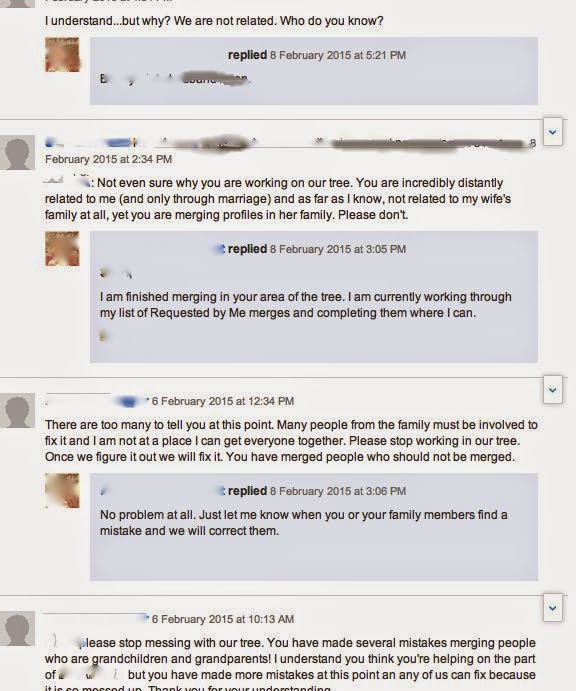
Above, I've taken steps so you won't recognize any names either. It's from the home page of the "merger" which I had immediately checked.  It turns out I'm not the only one who doesn't know who he is and is not okay with his "fixing" other people's family trees.  You'll also see that he is very unperturbed.  He says he is a volunteer Geni "curator" whose job it is to merge as many trees into the "World Family Tree" as possible.

I'm not getting into the pros and cons of "collaborative trees" here.  There are plenty of impassioned arguments going on in the comments sections of popular genealogy blogs and web sites.  Suffice it to say, I double-checked my privacy settings, all set to the maximum that Geni will allow, and discovered that Geni staff can go into any profile they please.  Our friend above said, in response to yet another exasperated request that he stop putting his oar in, that as a "curator", he has "special privileges".

That was enough for me.  I went straight to my Geni tree and set to work feverishly, first deleting my daughters' profiles which are supposed to be visible to family only.  As I worked through the morning, I discovered that if I deleted profiles in a certain order, that is, children, spouses, then siblings, then I could usually delete the profiles in my direct line.  When I couldn't, I went directly to the profile, and  sometimes could choose "delete"from the Actions menu.  Failing that, I used my old trick of manually erasing all information from the profile itself, using the "edit" tab.  Once that was done, I found I could delete those profiles as well.

By late afternoon, I had cleared my side of the tree to my name only, and the vast majority of the Resident Fan Boy's paternal relatives.  I'm leaving the RFB's maternal ancestors because, as I've said, it was those cousins who invited me in the first place.  Besides, they're usually the managers of those profiles, so I couldn't delete them anyway. (I can't delete my husband or his immediate family because other cousin manage their profiles, for example.)

For good measure, I went into my photo file at Geni, and deleted all photos of living relatives and my own deceased ancestors.

I will now wait and see if I get another snippy message.  If so, I will complete the job and close my account.

You can lecture me all you want about collaboration, Geni.  Cooperation still doesn't mean co-opting other people's work -- particularly without their permission.

Friday, 6 March 2015

A shadow of his former self

Oh, I had noble plans. I had the day mapped out. Then I ran into my father. The one who has been dead for six years. The one I haven't seen for many more years than that.

I have a British subscription to Find My Past, but the site is offering free world-wide access this weekend, so before embarking on the day's activities, I tried entering some familiar names. I stumbled across three articles about my dad, two with pictures, all from Bay Area newspapers which is where he settled after he left us for the final time. The articles themselves didn't contain anything of which I wasn't aware; they concerned his involvement with the local branches of Junior Achievement and the American Diabetes Association.

I wasn't prepared for the heavy sad feeling somewhere below my heart. In the first photo, he is back-lit in a group of four men, but I instantly recognized his stance, his posture and the shape of his head. It was taken when I was about the same age as younger daughter is now, and struggling through a haze of depression in the final months of high school. I noticed with another small shock, that the photo had appeared in the San Mateo Times. My aunt, my mother's sister, lived in San Mateo for many years.

The second photo was taken three years later, after I had decided, based on a dream I'd had, that he had died. I was staying with a family friend in Muswell Hill, in the house he'd often visited with my mother, and was haunted by what I had imagined were vestiges of him. The photo is crystal clear. He is unmistakeable.

It took me a while, but I recovered and got on with my day. I didn't weep. I saved the articles and archived them until I can decide a safer place to store them. As I have mentioned in this blog before, a number of people need to be safely off the planet before I can tell his story to those who remain.

Grief, it seems, takes strange shapes, as tangible as a knot in the stomach and insubstantial as a shadow. It returns in a different form every time.

Monday, 29 December 2014

Someone has my number

I follow Twisted Twigs on Gnarled Branches on Facebook with a horrified fascination.  

She gets a little too close for comfort on a regular basis.

This also gives you a clue to why I have little in the way of a post today.

Saturday, 27 December 2014

Not for the faint of heart

My husband has a German last name, inherited from his very English father, an Anglican archdeacon. His grandfather had a German forename as well, hastily anglicized during his service in the Royal Naval Reserve during the First World War, although he could speak German, having been tutored by his Berlin-born paternal aunt.

When I submitted my husband's DNA for testing about two years ago,  I felt sure that we might find out more through the Y-chromosome testing.  However, not a single instance of his surname showed up on the matches.  What was clear, though, was something we've long suspected: 14% of his genetic make-up comes out as Jewish - Ashkenazi, to be precise, with possible national connections to Poland, Ukraine, Lithuania.  Also, despite the relatively small percentage of his total DNA, the vast majority of his matches at the Family Tree DNA website, both for Y-chromosome and autosomal,  appear to be American Jews.

With no surname match, things went a little dead in the water - until about a month ago, when his surname turned up in the family tree of a recent autosomal match with connections to Berlin and Poznan. The latter city is currently in Poland, but has links to Germany.  I wrote a quick email to the American who had submitted his DNA.  He told us that he had a cousin living a few miles away in his home state of California who shared the Resident Fan Boy's surname and that this cousin would be taking the Y-DNA test soon.

So we wait.  If this cousin shows up in the Resident Fan Boy's Y-DNA matches, we will have a better idea of where his paternal line goes.  If not, it's back to the drawing board, though I'm anticipating an autosomal match at least.

There is a painful side effect and it's one I've long been expecting.  In the family tree of the man with the autosomal match are, as I've said, several members bearing my husband's surname. They are in the line of this man's paternal grandmother.  With a sinking heart, I noticed there are families whose death dates are all in the early 1940s.  When I clicked on the profiles, I saw the words: "Auschwitz" and "Theresianstadt".

Yes, I knew this would happen eventually, but all the intellectual preparation in the world doesn't lessen the blow of seeing the names of people with the same last name as my husband and children, knowing how they died, and knowing that, somehow, they are ours.